
Using AI for B2B Audience Research

AI is changing how businesses understand B2B audiences by replacing slow, manual methods with faster, more accurate tools. Instead of relying on outdated surveys or reports, AI analyzes real-time data from sources like CRM systems, website activity, and behavioral signals to deliver actionable insights in hours. These insights help businesses:
- Identify key accounts likely to convert using predictive scoring.
- Improve audience segmentation with behavior-driven data.
- Detect buying intent earlier, allowing for timely outreach.
Problems with Traditional B2B Audience Research
Traditional methods of B2B audience research are falling behind in addressing how buyers make decisions today. Many companies still depend on outdated tools like manual surveys, phone interviews, CRM exports, and static industry reports. These approaches struggle to capture the complexity of modern buying journeys, which now span search engines, social media, email, events, and product interactions. Buyers no longer follow a linear path; they research asynchronously, often involving multiple stakeholders across various channels. By the time traditional research methods produce results, the insights are often outdated, leaving sales and marketing teams relying on static snapshots instead of real-time, behavior-driven intelligence. This gap leads to several challenges, which we’ll explore below.
Manual Data Collection Takes Too Long
Manual research processes are notoriously slow, often taking weeks to complete. Teams spend countless hours exporting data from spreadsheets, coding survey responses, creating pivot tables, and assembling slide decks. While this work is ongoing, buyer behaviors and priorities can shift, making the data outdated by the time it’s ready for use. This delay hampers campaign launches and forces teams to rely on intuition rather than timely, data-backed decisions.
Poor Audience Segmentation
Traditional segmentation methods lean heavily on basic firmographic data like industry, company size, geography, and revenue, alongside simple contact details such as job title or seniority. This approach often ignores behavioral and intent-driven data, such as content engagement, product usage, or website activity. As a result, audience segments become overly broad and fail to reflect the nuances of modern buying behaviors. For example, a single target group might include both highly engaged prospects and inactive accounts, leading to generic messaging and wasted ad spend. Campaigns that don’t address specific pain points, buying stages, or decision-making dynamics tend to underperform, with lower conversion rates as a result.
Additionally, misalignment across teams exacerbates the problem. Marketing, sales, and product teams often create their own versions of target accounts, using different tools and priorities. This lack of consistency can lead to disputes over lead quality and misaligned targeting efforts, further reducing effectiveness.
Hard to Identify Buying Intent
The challenges in segmentation also make it harder to identify true buying intent. Traditional methods often rely on lagging indicators like form fills, event attendance, or basic email engagement. These signals, while useful, miss the earlier, more subtle signs of interest – such as specific content consumption or cross-channel research activity. Furthermore, these approaches struggle to track anonymous behavior across devices and platforms, leaving much of the pre-form-fill journey invisible. This is especially problematic in complex, committee-driven B2B sales cycles.
Without advanced tools to score and analyze multiple behavioral signals, all engagement is often treated equally. This makes it difficult to separate casual interest from genuine purchase intent. As a result, sales teams frequently waste time on low-quality leads while overlooking accounts that are truly in-market. To make matters worse, the slow detection of active research signals gives competitors with faster systems a head start in reaching decision-makers, reducing win rates and extending deal timelines.
How AI Solves B2B Audience Research Problems
AI has revolutionized how businesses conduct audience research, turning what used to be a tedious, manual process into an automated one that delivers insights in hours instead of weeks. Instead of relying on outdated reports, AI tools continuously draw data from CRM systems, website analytics, product usage platforms, social listening tools, and firmographic databases. These tools then consolidate all that information into a unified, real-time view of each account. Take ZoomInfo, for instance – it uses AI to analyze hundreds of data points from a database containing over 400 million professional contacts and 100 million company profiles. By automatically recommending best-fit accounts and tracking billions of digital interactions for intent signals, it eliminates the need for manual data entry and spreadsheet juggling, tasks that once consumed entire workdays. This seamless integration of data paves the way for more in-depth, automated analysis.
Automated Data Processing
AI can process millions of behavioral signals in seconds, cleaning and unifying data effortlessly while updating segments and uncovering new patterns without requiring human input. Traditional methods of prospecting often miss up to 80% of buying intent signals. In contrast, tools like Origami Agents scan over 100,000 data sources daily, detecting critical buying signals – such as funding announcements, leadership changes, or competitor mentions – within hours of their occurrence. This speed advantage allows U.S. B2B teams to act on fresh intelligence rather than outdated data, ensuring their campaigns are based on accurate and timely information.
Better Audience Segmentation with Behavioral Data
AI takes audience segmentation to a whole new level, moving beyond basic firmographic details like industry or company size. These platforms analyze behavioral data – such as pages visited, content downloads, product usage, and email interactions – alongside psychographic and interest-based data, including topics of engagement and social media activity. For example, instead of broadly categorizing an account as "mid-market SaaS", AI can identify specific targets, like finance leaders who have actively engaged with pricing and ROI content within the past two weeks. This level of precision provides U.S. sales and marketing teams with actionable insights. Some tools even go a step further, inferring motivations and challenges at the persona level from aggregated data. This allows for segmentation that reflects psychological drivers rather than just job titles. By uncovering high-value micro-segments, teams can craft personalized messaging that leads to higher email engagement and conversion rates.
Predicting Buying Intent
AI-powered intent models use historical conversion data combined with real-time engagement signals to assess how likely an account is to make a purchase. These models consider factors like the frequency and recency of website visits, the type of content consumed (e.g., pricing pages or case studies), product trial activity, email engagement, and external intent data, such as research on competitors or specific topics. Platforms like Demandbase employ predictive scoring to rank accounts by their likelihood of converting, enabling sales teams to focus their outreach on the most promising opportunities. This data-driven prioritization replaces guesswork, aligning marketing and sales teams so they can concentrate their time and resources on accounts that are ready to engage. High-intent accounts can also trigger tailored strategies, such as account-based ads, personalized email campaigns, or direct sales outreach, streamlining efforts and accelerating pipeline velocity for U.S. revenue teams. These predictive tools set the stage for implementing AI-driven research strategies effectively.
How to Implement AI in Your B2B Audience Research
AI has reshaped how businesses approach research, offering tools to uncover deeper insights and streamline processes. Here’s a practical guide to incorporating AI into your B2B audience research.
Define Your Ideal Customer Profile
Creating an effective customer profile is the first step to leveraging AI insights. Start by consolidating first-party data from your CRM, marketing automation tools, and website analytics into a unified view of accounts and contacts. This combined dataset serves as the foundation for training AI models.
Analyze your past 12–24 months of deals – both won and lost – to identify patterns. Look for shared characteristics like:
- Firmographics: Industry, company size, revenue range.
- Technographics: Tools and platforms used by your customers.
- Buying Roles: Decision-makers and influencers in the purchase process.
- Key Metrics: Deal size, sales cycle length, and other relevant indicators.
AI platforms like Delve AI can help refine this data further by incorporating website behavior, survey results, and competitive intelligence. Use these tools to automatically generate personas, and then validate these AI-generated profiles with feedback from sales and customer success teams. The goal is to create a clear Ideal Customer Profile (ICP) that includes both static details – like industry and company size – and dynamic signals such as content preferences, product usage trends, and intent keywords that AI tools can track on a large scale.
Choose and Integrate AI Tools
Selecting the right AI tools is crucial. Look for platforms that align with your goals, offer strong predictive capabilities, and integrate seamlessly with your existing systems. For example:
- ZoomInfo: Ideal for data enrichment and contact discovery.
- 6sense and Demandbase: Focused on account-level intent tracking and predictive scoring.
Ensure the tools you choose can connect with your CRM (e.g., Salesforce, HubSpot) and marketing automation platforms. Use your CRM as the central repository for accounts, contacts, and opportunities. Configure your AI tools to sync with this system, either through native integrations or APIs. For instance, connecting 6sense to Salesforce allows automatic updates to account data and scoring fields.
To maintain data integrity, establish clear governance rules. Define field naming conventions, set guidelines for updates (e.g., ensuring AI doesn’t overwrite critical fields like ownership or status), and determine sync frequency. Document these workflows so your team can easily interpret and act on the insights generated by AI.
Analyze Results and Improve Segments
Once your AI tools are active, monitor performance metrics regularly – monthly or quarterly. Key metrics to track include:
- Pipeline created
- Win rate
- Average deal size (in USD)
- Sales cycle length
Compare these metrics across different segments against your benchmarks. Identify high-performing groups that generate the most value and move quickly through the pipeline. For segments that underperform, analyze engagement data (e.g., email opens, site visits, content downloads) and gather input from your sales team.
AI platforms can also highlight emerging trends or new micro-segments. Validate these findings by running A/B tests and comparing conversion rates. Based on the results, adjust your ICP criteria – this could mean narrowing your focus on specific industries, revising company size ranges, or refining intent signals. Update these changes in both your AI platform and CRM.
To keep your segmentation strategy effective, schedule regular check-ins with your marketing and sales teams. These meetings should focus on reviewing AI recommendations, addressing anomalies, and ensuring everyone understands the logic behind the segmentation. This transparency helps avoid “black-box” decisions that could undermine trust in the system.
Next up, explore how to measure the impact of these AI-driven strategies.
Measuring Results from AI-Driven Audience Research
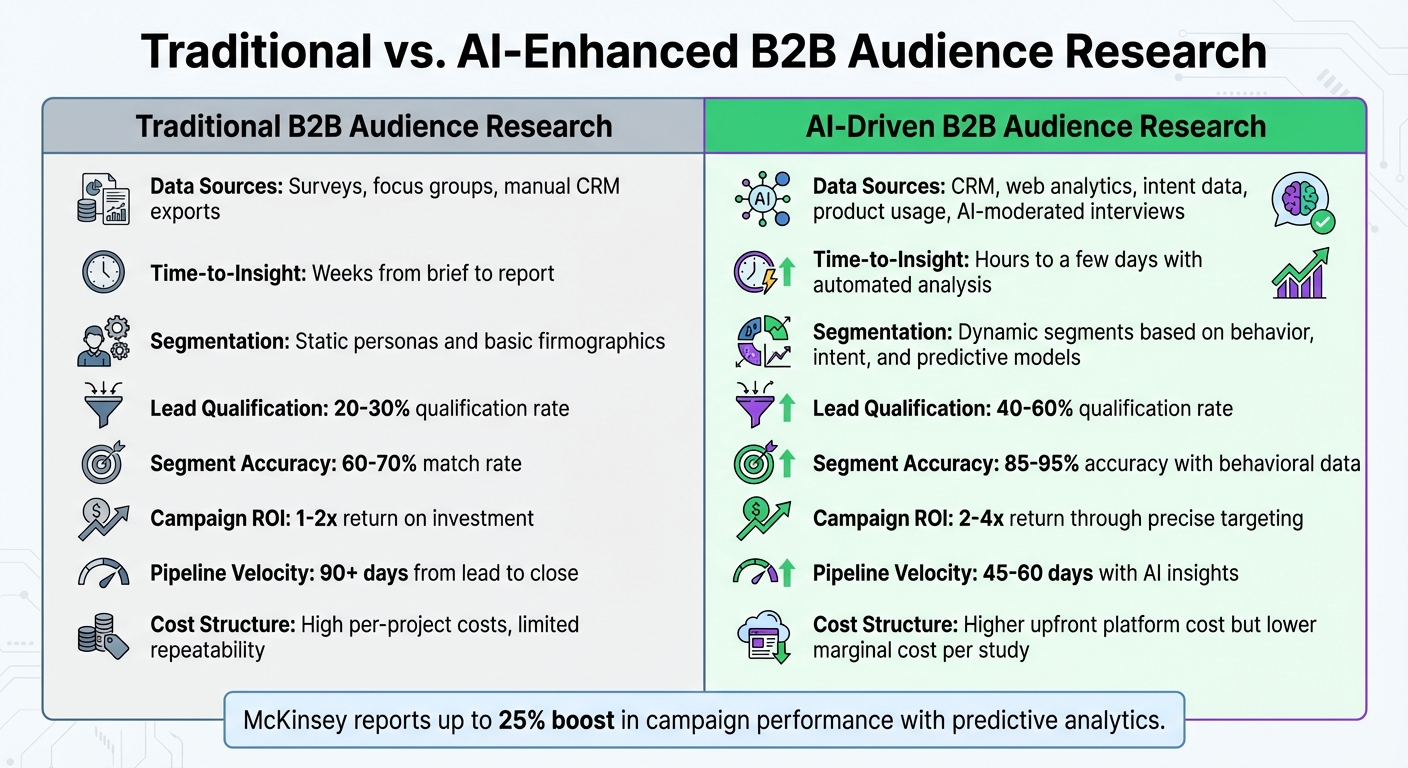
Traditional vs AI-Driven B2B Audience Research: Performance Metrics Comparison
Key Metrics to Track
When assessing the impact of AI on audience research, it’s crucial to focus on metrics that reveal whether your investment is delivering results. Start with lead qualification rates, which measure the percentage of leads that meet your sales-ready criteria. AI can push these rates from 20-30% up to 40-60% by pinpointing high-intent prospects. For example, CRM systems integrated with AI have been shown to increase qualified leads by as much as 25%.
Another critical metric is segment accuracy, which evaluates how well your audience groupings align with actual behaviors. AI tools often raise segment accuracy from 60-70% to an impressive 85-95%, driving returns of 2-4 times your investment.
Pipeline velocity, or the time it takes to move a lead from initial contact to closure, is another area where AI shines. By leveraging predictive buying intent signals, AI can speed up this process by 20-50%, reducing sales cycles from over 90 days to just 45-60 days.
To effectively monitor these metrics, use CRM dashboards to track performance and compare improvements against your baseline. Incorporate A/B testing within audience segments to validate these enhancements, while ensuring your data governance practices maintain consistency and reliability across systems.
These metrics underscore how AI can significantly boost operational efficiency, as outlined in the comparison below.
Traditional vs. AI-Enhanced Methods
The contrast between traditional and AI-driven approaches to B2B audience research highlights the transformative power of AI. Here’s a side-by-side look at how the two methods stack up:
| Aspect | Traditional B2B Audience Research | AI-Driven B2B Audience Research |
|---|---|---|
| Data Sources | Surveys, focus groups, manual CRM exports | Combines CRM, web analytics, intent data, product usage, and AI-moderated interviews |
| Time-to-Insight | Weeks from brief to report | Hours to a few days with automated analysis |
| Segmentation | Static personas and basic firmographics | Dynamic segments based on behavior, intent, and predictive models |
| Lead Qualification | 20-30% qualification rate | 40-60% qualification rate with predictive scoring |
| Segment Accuracy | 60-70% match rate | 85-95% accuracy with behavioral data |
| Campaign ROI | 1-2x return on investment | 2-4x return through precise targeting |
| Pipeline Velocity | 90+ days from lead to close | 45-60 days with AI insights |
| Cost Structure | High per-project costs, limited repeatability | Higher upfront platform cost but lower marginal cost per study, allowing for frequent testing |
According to McKinsey, businesses that adopt predictive analytics in their marketing efforts report up to a 25% boost in campaign performance. The real advantage of AI isn’t just its speed – it’s the ability to continuously refine audience insights and pivot strategies in real time, avoiding the delays of traditional research cycles.
Conclusion
AI has completely transformed the way B2B teams understand and connect with their audiences. While traditional research offers a static snapshot, AI provides a real-time pulse on who your ideal buyers are, what matters most to them, and when they’re ready to engage. By shifting from fixed personas to flexible, behavior-based insights, companies are seeing measurable improvements in their marketing efforts. B2B firms leveraging AI for audience research can adapt quickly to market changes, respond to buyer signals faster, and focus on high-value accounts. This approach not only enables personalized marketing at scale but also drives better ROI, leading to pipeline growth and higher revenue. By addressing the shortcomings of traditional methods, AI equips businesses to tackle industry challenges head-on and implement strategies that deliver immediate results.
If you’re ready to put these insights into action, start with a focused plan. Kick off a 90-day pilot targeting a high-value segment or account list. Use AI for tasks like segmentation, predictive scoring, and content personalization, and then compare the outcomes with your traditional methods. Track clear metrics – such as demo requests, sales-qualified lead (SQL) rates, or pipeline velocity – to assess the impact of AI on your efforts.
Looking to take it further? Partner with Dreamtown Creative to turn your AI-driven audience insights into compelling brand stories, optimized websites and landing pages, and corporate videos tailored to your most valuable segments. Combining AI-powered research with expert creative execution can turn insights into tangible growth.
AI has redefined B2B audience research. Embrace it now to stay ahead of the competition and lead your market.
FAQs
How does AI enhance B2B audience segmentation?
AI is transforming how businesses approach B2B audience segmentation. By leveraging advanced data analytics and machine learning, companies can sift through massive datasets, spot patterns, and develop detailed customer personas. This leads to more accurate and effective targeting.
With these insights, businesses can fine-tune their marketing strategies. AI helps predict customer behaviors, craft tailored messages, and deliver personalized experiences. The outcome? A stronger connection with the audience and better-performing campaigns.
What are the advantages of using AI to identify buying intent compared to traditional methods?
AI brings a powerful edge to understanding buying intent by processing massive datasets with speed and precision. It can uncover subtle patterns and behaviors that human analysis might overlook, offering real-time insights into what customers want and how they act.
Traditional methods often depend on smaller datasets and require lengthy manual efforts. In contrast, AI delivers faster, more comprehensive results, enabling businesses to make smarter decisions. This means companies can fine-tune their strategies to better meet customer needs and fuel their growth.
How can businesses use AI to improve B2B audience research?
Businesses can leverage AI to simplify and improve their B2B audience research. AI can handle tasks like automating data collection, analyzing massive datasets for trends, and building detailed customer profiles. With its ability to spot patterns that might go unnoticed by humans, AI provides richer insights into audience behavior and preferences.
Using AI-powered platforms, companies can refine their audience segmentation, pinpoint valuable opportunities, and craft more precise marketing strategies that truly connect with their target audience. This method not only saves time but also supports smarter, data-backed decisions.