How to Design a Custom Customer Persona Template
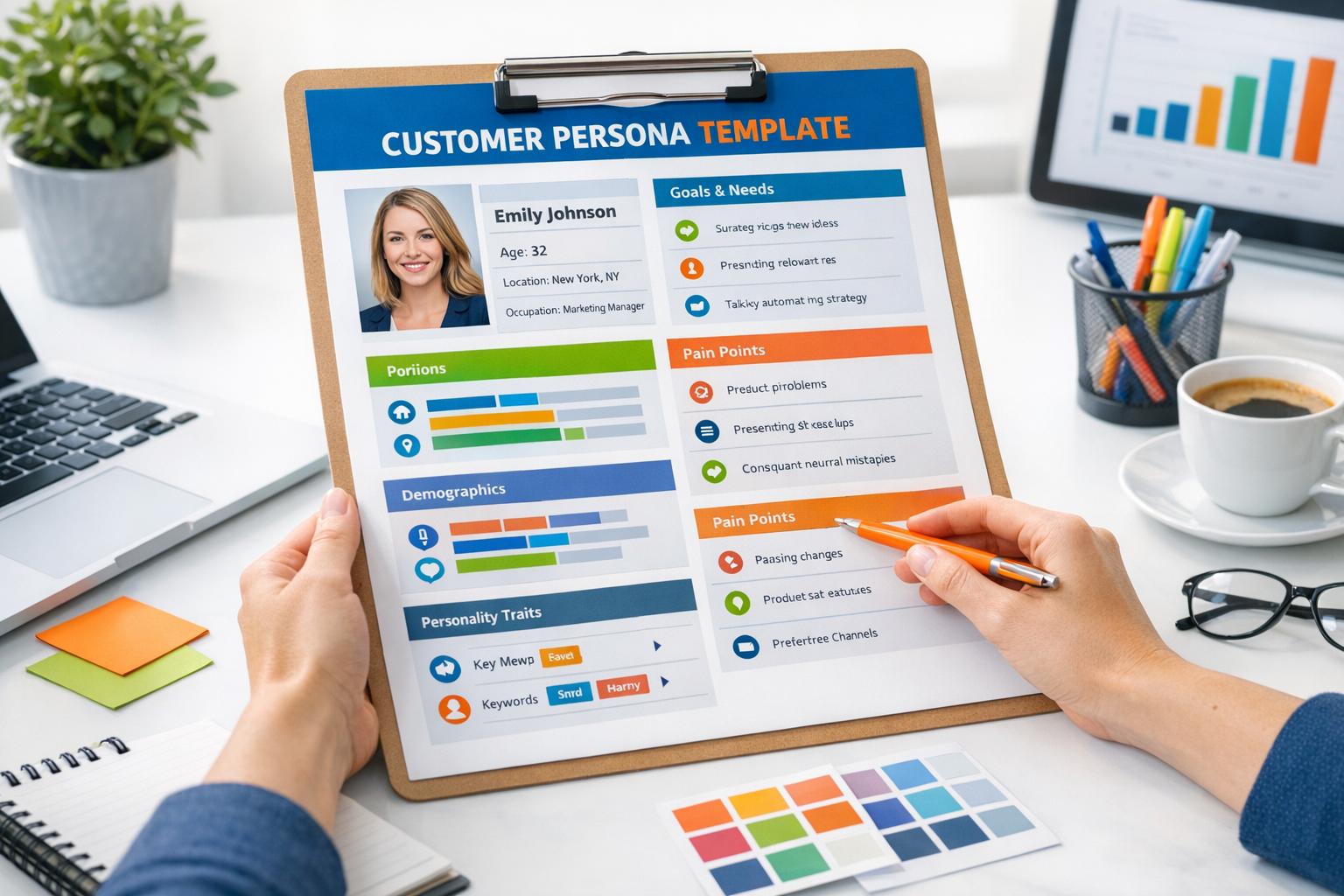
Want to create marketing that resonates? It starts with understanding your audience. A customer persona template is a detailed profile of your ideal customer, built from real data. It goes beyond basic demographics to explore behaviors, motivations, and challenges. Why does this matter? Companies with documented personas are 71% more likely to exceed revenue goals, and personalized strategies can boost engagement by 10-20%.
Here’s a quick breakdown of the process:
- Set Goals & Collect Data: Define what you want to achieve and gather insights from tools like CRMs, Google Analytics, and customer interviews.
- Segment Your Audience: Group customers by shared traits like pain points or buying triggers.
- Design the Template: Include actionable details like goals, objections, and decision criteria.
- Add Visuals & Structure: Use photos, clear sections, and real quotes to make personas relatable.
- Test & Update: Gather feedback, refine, and keep personas current as your audience evolves.
A well-designed persona template helps align teams, improve marketing strategies, and focus on leads that drive results.
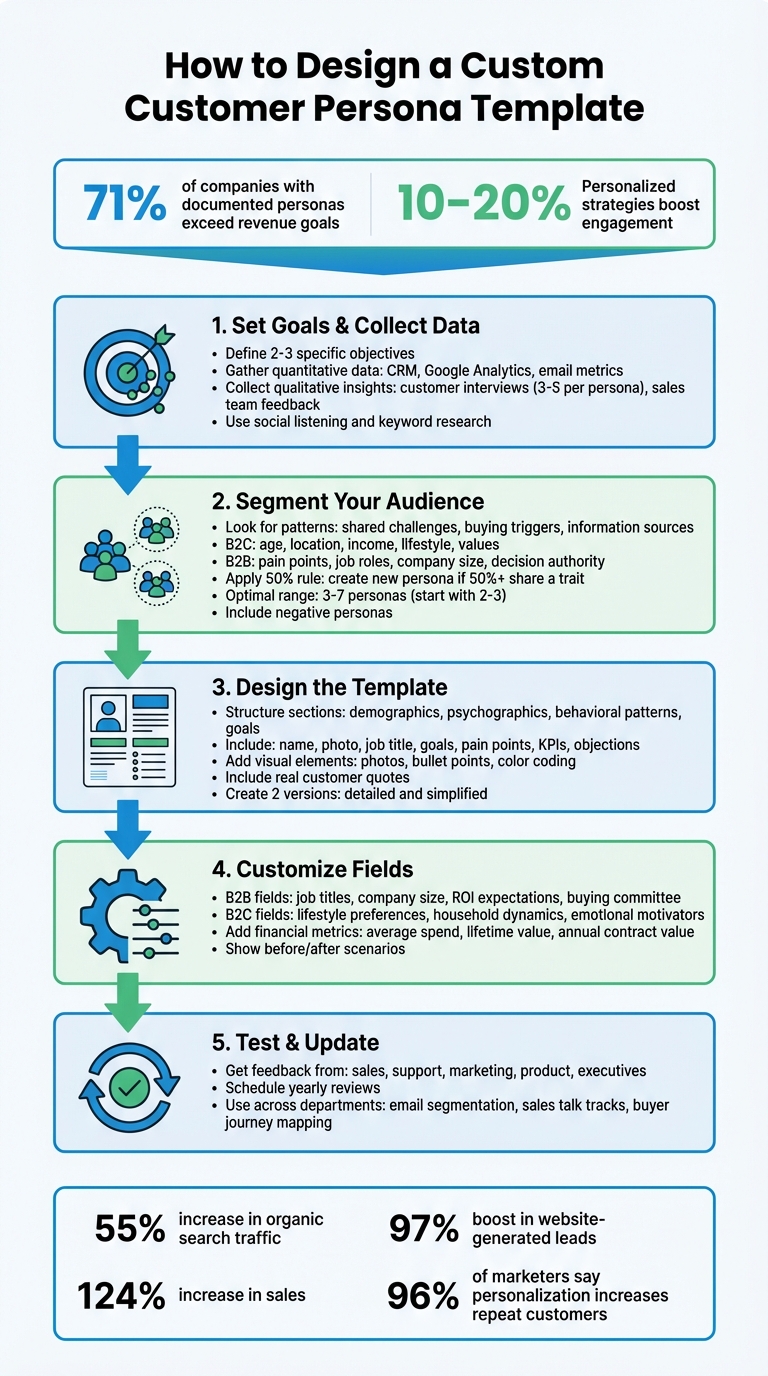
5-Step Process to Create a Custom Customer Persona Template
Step 1: Set Your Goals and Collect Data
Before diving into creating your persona template, take the time to define your objectives and identify your data sources. Without a clear plan, you might end up with profiles that look polished but fail to guide your team toward smarter decisions.
Decide What You Want to Accomplish
Start by pinpointing 2–3 specific goals for your persona development. For example, are you looking to improve lead quality so your sales team can focus on better prospects? Or maybe you want to figure out which content formats resonate most with your audience, ensuring your budget isn’t wasted on ineffective channels. Another possibility is aligning your marketing and sales teams around a unified understanding of your target customer.
You can also apply personas to product development. Take this example: a software company analyzed survey data and discovered a significant group of e-commerce users. This insight led to a targeted product update, including an upgraded Shopify integration. Additionally, consider defining "negative personas" – those customers who are too costly to acquire or unlikely to buy. This helps you zero in on the segments that truly drive revenue.
Once your goals are clear, you’re ready to start gathering data from a variety of sources.
Gather Data from Multiple Sources
Strong personas blend numbers (the "what") with personal insights (the "why"). Start by pulling quantitative data from tools like your CRM to uncover purchase trends and customer lifetime value. Check Google Analytics for traffic sources, audience demographics, and behavioral patterns. Dive into your email metrics to see which subject lines and content types get the most engagement.
Then, layer in qualitative insights. Talk to your sales and support teams – they often have firsthand knowledge of customer objections and favorite features. Conduct interviews with 3–5 individuals per persona to identify recurring themes. For instance, Flori Needle, editor of HubSpot’s Breaking the Blueprint column, used targeted surveys to explore the challenges faced by minority business owners. By addressing the unique pain points of Black entrepreneurs, her team created content that delivered measurable results for that audience.
Don’t forget to analyze how your customers talk. Use social listening tools or keyword research to understand their language. Record customer calls (with permission) to build a library of real customer feedback that can be shared with new hires or stakeholders. To boost survey participation, consider offering small incentives – it’s a simple way to gather more responses.
Step 2: Divide Your Audience and Choose What to Include
Group Customers into Segments
Once you’ve gathered your data, take a closer look for patterns that can help you identify distinct customer groups. Look for shared challenges, common objections, triggers for making purchases, and the sources they rely on for information. For B2C businesses, segmentation often revolves around factors like age, location, income, lifestyle, and values. On the other hand, B2B companies typically focus on pain points, job roles, company size, and decision-making authority.
A helpful guideline is the 50% rule: create a new persona if at least half of your respondents share a specific goal or characteristic. Most businesses find that 3–7 personas work well, but starting with 2–3 high-impact personas can be a practical first step.
Don’t forget about negative personas – those individuals who are either too costly to acquire or unlikely to make a purchase. Examples include customers focused solely on price who frequently return items or those whose needs go beyond what your product can deliver. Knowing who you don’t want to target can save your marketing team from wasting time and resources.
Once your segments are clearly defined, it’s time to decide which specific details will help turn these insights into actionable persona profiles.
List the Core Details to Include
When building your customer persona template, focus on details that offer actionable insights rather than just collecting basic demographic data. As Jodi Harris, Director of Content Strategy at Content Marketing Institute, explains:
If you don’t have a specific way to turn a particular data point into an actionable customer insight, it’s best to leave it out of the persona.
- Jodi Harris
Start with the basics: a fictional name (like "HR Coordinator Colin"), a representative photo, age, location, and job title. Then, add professional context, such as the industry they work in, the size of their company, their daily responsibilities, and career trajectory. Behavioral insights like preferred communication channels, social media habits, and the brands they admire can also be helpful.
To make your persona a true marketing asset, dive deeper. Include their goals, pain points, buying context, key performance indicators (KPIs), and common objections. Identify their professional metrics for success, personal aspirations, frustrations with existing solutions, and what influences their buying decisions. Consider their role in the purchasing process and the criteria they use to evaluate products or services. This level of detail pays off – 96% of marketers say personalization increases the chances of turning buyers into repeat customers.
Step 3: Create the Layout and Structure
Build a Clear Structure
To make your personas practical and easy for your team to use, start by organizing your data into a structured template. Break it into sections like demographics, psychographics, behavioral patterns, and goals. If you’re working on B2B personas, focus on professional details, while B2C personas should lean into lifestyle traits.
The best templates don’t just list facts – they connect the dots. Jodi Harris, Director of Content Strategy at Content Marketing Institute, explains:
Documenting your personas, even if it is done in a quick way, is key to keeping everybody focused on the same audience.
- Jodi Harris
Consider tailoring parts of the template for specific departments. For example:
- Sales might benefit from a "Common Objections" section.
- Marketing could use "Preferred Content Formats".
- Customer support might need a "Frequent Questions" section.
Kick things off with a "Persona Purpose" section at the top. This should outline the business goals the persona supports and specify which teams will reference it. This ensures everyone knows how the persona fits into their daily tasks.
To keep things manageable, create two versions of the template: one detailed version for content creators and a simplified, high-level version for general team use. This way, you avoid overwhelming people while still providing the depth needed for specific tasks.
Once your structure is complete, bring it to life with engaging visuals.
Add Visual Elements
A visually appealing template not only communicates information but also helps your team connect with the persona on a human level. Start by adding a photo or illustration to represent the persona, paired with a memorable name like "Efficiency Seeker Marcus" or "HR Coordinator Colin." This small touch makes the persona feel like a real person instead of just data on a page.
Design your template with clarity in mind. Use bullet points and headers to make key details easy to find, especially during a sales call or campaign brainstorm. Visual tools like sliding scales or bar graphics can illustrate personality traits – perhaps showing where the persona falls between instinctive and deliberative decision-making. Color coding can also help differentiate segments, such as first-time users versus enterprise clients.
To add authenticity, include real customer quotes in a dedicated section. These quotes highlight actual pain points and language, helping your team communicate in ways that resonate with your audience. The ultimate goal? Create a template that your team actively uses – not one that gets buried in a shared drive.
Step 4: Customize Fields and Add Useful Frameworks
Choose Which Fields to Include
Focus on data points that directly lead to actionable insights. When creating B2B templates, emphasize professional details like job titles, company size, ROI expectations, and the role of the buying committee. On the other hand, B2C templates should lean into lifestyle preferences, household dynamics, and emotional motivators. The impact of using buyer personas is clear: 71% of businesses that document them exceed revenue goals, and those leveraging personas are twice as likely to hit their targets.
To make your personas practical, include fields that empower your team to act. For sales teams, financial metrics such as average spend, lifetime value, and annual contract value can help qualify leads. For marketing efforts, track preferred content formats, social media habits, and key decision triggers – specific events like contract renewals or mergers that prompt a search for solutions. Additionally, identify traits that separate high-value prospects from less qualified ones. For example, flag price-sensitive shoppers with high return rates or individuals who only engage with free resources. Filtering out unqualified leads saves resources and lets your team focus on more promising opportunities.
Once you’ve outlined the key fields, take it a step further by illustrating their value with a transformation narrative.
Show Before and After Scenarios
Using a before-and-after framework turns your persona into a compelling story. This approach highlights the current state – their daily challenges, failed attempts at solutions, and obstacles to progress – versus the desired state, where your product successfully resolves their issues. It’s a powerful way to demonstrate how your product drives meaningful change.
Alicia Schneider from monday.com explains:
This framework makes it easier to craft messaging showing the transformation your product provides.
- Alicia Schneider
Incorporate real quotes from customer interviews to ground these scenarios in reality, avoiding assumptions. Pinpoint the specific events that prompted their search for a solution to make the "before" scenario relatable and actionable.
This method delivers measurable results. For instance, B2B companies that effectively use personas have seen organic search traffic increase by 55%. Moreover, implementing personas can boost website-generated leads by 97% and drive sales up by 124%. By showing customers where they are now and where they could be, you equip your team with the tools to sell transformation rather than just features.
Step 5: Test, Improve, and Put It to Work
Get Feedback and Make Changes
Once your template is ready, it’s time to see how it holds up in the real world. Share it with the people who interact with customers daily – sales, support, marketing, product design, and even executives. Their feedback can reveal whether the persona truly captures the customer’s needs and pain points, aligning with actual conversations and experiences.
Ask questions like: Does this template accurately represent the customer group? Are there any missing details? Is the format easy to understand? To make it more functional, consider creating two versions: a detailed one for content creators and a more streamlined version for broader use. Sharing raw customer data, like interview recordings, can also help bring the persona to life and ensure the customer’s voice is heard.
Remember, personas aren’t static. They need to evolve as your market and customers change. Schedule yearly reviews to update them based on new trends and insights. As Luca Lyons from Groove wisely points out:
Personas are like products – they’re never finished.
- Luca Lyons
By integrating feedback and keeping your personas up to date, you’ll ensure they remain accurate and relevant.
Use the Template in Your Marketing
Once validated, put your improved persona into action. Make it a central tool across all departments to create a unified focus on the customer. Printing copies and placing them in visible areas can keep the customer top of mind for your team.
Personas can be incredibly useful in marketing. Use them to segment email lists, craft personalized subject lines, and build lookalike audiences. For sales teams, develop persona-specific talk tracks and compile lists of common objections to help prepare for customer conversations. Map each persona to the buyer’s journey – awareness, consideration, and purchase – so you can provide the right information at every stage. Jodi Harris, Director of Content Strategy at Content Marketing Institute, highlights the importance of this:
Having documented personas, even in their simplest forms, will not only help you crystallize your ideas, but also serve as a single version of truth for everybody creating content for your organization.
- Jodi Harris
Conclusion
Creating a custom customer persona template is a continuous effort that pays off across your entire organization. By following five key steps – setting clear objectives, segmenting your audience, designing a structured framework, tailoring fields to your needs, and consistently testing – you’ll craft a tool that empowers teams in sales, product development, and marketing to better understand your customers.
Research shows that documented personas can boost revenue, improve engagement, and increase customer retention rates. They provide clarity that sharpens messaging and informs strategic decisions across various departments.
When integrated into everyday workflows, your persona template becomes a vital resource for team alignment. As Jodi Harris explains, it acts as a shared reference point, helping marketing, sales, and product teams stay on the same page about who your customer is. This shared understanding minimizes wasted efforts, enhances communication, and guides product development to address real customer needs.
Keep in mind, customer personas are not static. As discussed earlier, schedule annual reviews to ensure they reflect evolving market trends and changing customer behaviors. Adele Revella from the Buyer Persona Institute emphasizes this point:
The only reason to build a new persona is when it allows marketers to create something more effective, more compelling, or more persuasive for a buyer.
- Adele Revella
FAQs
What should be included in a customer persona template?
A well-thought-out customer persona template should cover essential details like:
- Demographic information: This includes age, gender, location, job, income level, and education.
- Psychographics: Dive into their values, interests, lifestyle choices, and personality traits.
- Goals and motivations: Understand what drives your ideal customer and what they’re striving to accomplish.
- Challenges and pain points: Identify their struggles or obstacles that your product or service can address.
- Behaviors and patterns: Look at their buying habits, preferred ways of communicating, and how they make decisions.
By including these components, you can build a clear picture of your ideal customer. This makes it much easier to fine-tune your marketing and create strategies that genuinely connect with your audience.
How can I collect and use customer data to create effective personas?
To build strong customer personas, start by collecting information directly from your audience. Use interviews, surveys, and analytics tools to gather insights. Pay attention to recurring patterns in their goals, challenges, and behaviors. Break this data down into two categories: demographics (like age, location, and income) and psychographics (such as values, interests, and motivations). This approach ensures you get a clear and balanced view of your customers.
After gathering the data, turn it into a semi-fictional profile that reflects your ideal customer. These personas act as a guide for your marketing strategies, content creation, and product development. When personas are rooted in research, they help you make smarter decisions and create experiences that genuinely address your customers’ needs.
Why should you update your customer personas regularly?
Keeping your customer personas current is crucial to accurately reflect your audience’s evolving behaviors, needs, and preferences. Over time, shifts in market trends, customer motivations, and purchasing habits can render outdated personas ineffective, potentially undermining your marketing efforts.
By revisiting and refining your personas regularly, you can fine-tune your campaigns to better meet customer expectations, ensuring your strategies remain relevant and impactful. This approach not only strengthens your connection with your audience but also helps you maintain a competitive edge in a rapidly changing market.