
How AI Improves Social Media Personalization

AI is changing how social media platforms deliver content, making it more personal and relevant to users. By analyzing behavior like likes, shares, and comments, AI tailors feeds, ads, and recommendations to individual preferences. Businesses leveraging these tools report higher engagement, better ad performance, and reduced costs. Key technologies driving this shift include:
- Machine Learning: Tracks user behavior to prioritize content that grabs attention.
- Natural Language Processing (NLP): Understands text and speech to customize recommendations.
- Predictive Analytics: Anticipates user needs based on past interactions.
For example, brands like Marriott Bonvoy and Wowcher have used AI to achieve millions of engagements and lower campaign costs. AI also enables scalable personalization, automates repetitive tasks, and optimizes ad targeting. However, balancing AI with human oversight ensures content feels genuine and aligns with brand identity.
AI tools like Sprout Social, Buffer, and Dynamic Yield simplify this process, offering real-time insights, content adjustments, and workflow efficiency. As AI continues to evolve, features like multimodal learning and hyper-personalization will further enhance user experiences, while transparency and human involvement remain key to success.
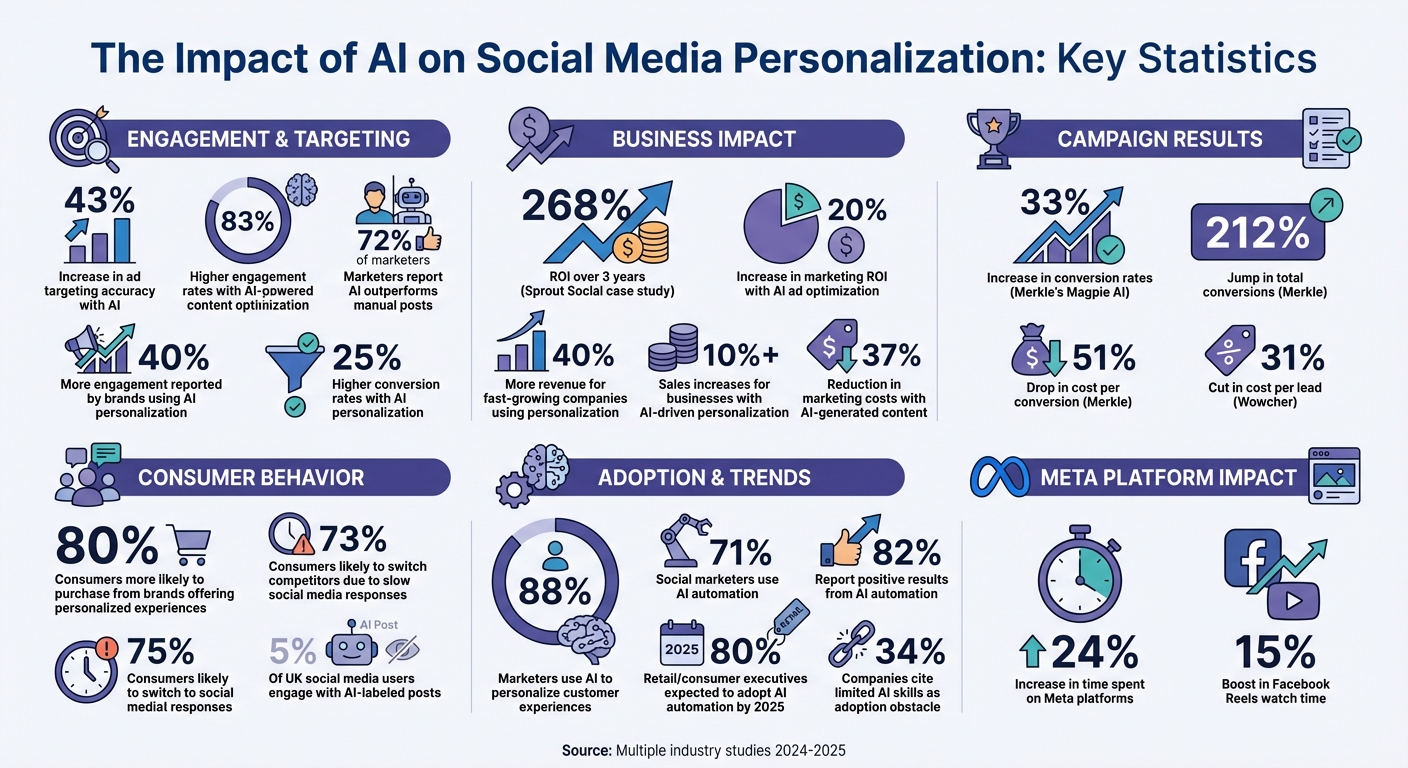
AI Social Media Personalization Impact Statistics and ROI
AI Techniques That Power Social Media Personalization
Social media platforms rely on three key AI technologies to create a personalized experience: machine learning, natural language processing (NLP), and predictive analytics. Each plays a unique role in understanding user behavior, tailoring content, and anticipating future preferences.
Machine Learning for Behavior Analysis
Machine learning algorithms dig deep into your actions – like how long you watch a video, what posts you save, and how you engage with content. By analyzing millions of interactions, these systems uncover patterns that reveal your preferences.
Here’s how it works: First, the algorithm scans your past activity to identify posts you might like. Then, it ranks these posts based on how likely they are to grab your attention. Finally, the top-ranked content is displayed on your feed. This approach has proven effective, with businesses using AI in social media advertising reporting a 43% boost in targeting accuracy.
Different platforms prioritize different behaviors. For example:
- TikTok focuses on video completion rates, rewarding content that keeps viewers hooked until the end.
- Instagram values saves and shares, favoring content users want to revisit or share with others.
- LinkedIn measures dwell time – how long users pause to read posts.
For creators, this means tailoring content to each platform’s unique algorithm. TikTok creators aim to hook viewers within seconds, Instagram posts benefit from shareable guides, and LinkedIn posts perform well when they’re detailed and thoughtful, typically around 1,200–1,500 characters.
| Platform | Primary ML Focus | Key Engagement Signal |
|---|---|---|
| TikTok | Content consumption patterns | Video completion rate and rewatches |
| Visual and relationship scoring | Saves, shares, and image/object recognition | |
| Professional relevance | Dwell time (time spent reading) | |
| Social graph analysis | Relationship web and group dynamics |
Once behavior is mapped, NLP takes personalization further by interpreting the context and sentiment behind user interactions.
Natural Language Processing for Content Customization
NLP deciphers the meaning behind the words users type or speak, whether in captions, comments, or videos. It identifies sentiment, tone, and intent, allowing platforms to fine-tune content recommendations.
"AI can parse conversations more accurately, using natural language processing (NLP) to overcome inhibitions like regional dialects and grammatical flaws that would previously distort insights." – Sprinklr
Modern NLP doesn’t just analyze text; it also processes spoken words. For instance, if you watch cooking videos where chefs mention “quick weeknight dinners,” the algorithm picks up on that phrase and suggests similar content – even if the video titles don’t include those exact words. This capability is why spoken keywords now influence recommendations on platforms like Instagram and TikTok.
Brands are also tapping into NLP to craft personalized captions. Instead of using a one-size-fits-all approach, AI tools generate multiple caption variants – tailored to match different tones, such as professional, casual, or humorous. Businesses that adopt this strategy have reduced marketing costs by up to 37%.
Predictive Analytics for Anticipating User Needs
Predictive analytics uses your past behavior – likes, shares, searches – to guess what you’ll want next. That’s why you might see ads for hiking boots after researching trails or why back-to-school promotions flood your feed as summer ends.
This technology doesn’t just predict your interests; it also helps marketers optimize their strategies. By analyzing engagement trends, predictive models estimate click-through rates, conversions, and the best times to post content. This insight allows businesses to allocate resources more effectively.
Looking ahead, predictive analytics is set to transform industries. By 2025, 80% of retail and consumer executives are expected to adopt AI automation to streamline processes. Platforms are shifting from analyzing past trends to making real-time adjustments. For example, the feed you see at 9:00 AM could look entirely different by 9:00 PM, thanks to live data analysis that adapts content to your evolving behavior. This ability to adjust instantly ensures that your experience stays relevant throughout the day.
Benefits of AI-Driven Social Media Personalization
AI’s ability to analyze and customize content offers businesses advantages that go beyond just boosting engagement. It also improves ad performance and enables scalable personalization without the need for additional staff. By leveraging AI, companies can achieve higher engagement, more effective advertising, and personalized experiences at scale.
Better User Engagement Through Relevant Content
AI excels at understanding user preferences by analyzing what people like, comment on, and save. Social media platforms use this data to curate feeds that keep users engaged, prioritizing content that aligns with their interests. Plus, AI determines the best times to post based on when specific audience segments are most active, ensuring content gets maximum visibility.
For example, if you’re always watching cooking videos, your feed will likely feature more recipes. Similarly, saving travel guides will lead to more destination-related posts. This personalized approach not only keeps users satisfied but also helps brands reach their target audience more effectively.
AI also uses sentiment analysis to monitor the emotional tone of comments and mentions. This helps brands gauge how audiences feel about their content. With real-time feedback, businesses can tweak their messaging before negative sentiment gains traction.
More Effective Advertising with Dynamic Targeting
AI doesn’t just personalize feeds – it transforms advertising by targeting audiences with precision. Traditional ads often focus on broad demographics like age or location, but AI digs deeper, analyzing behaviors to predict who is most likely to click or make a purchase. Companies using AI for ad targeting have reported a 43% increase in success rates.
Here’s how it works: AI platforms analyze engagement metrics in real time, continuously refining ad content and delivery. Budgets are automatically shifted toward the best-performing ad variations through ongoing A/B testing. This eliminates the need for manual adjustments while identifying the most effective combinations of visuals, headlines, and calls-to-action.
Dynamic creative generation takes this a step further. AI tools can produce multiple versions of ads – different images, videos, and copy – and test them simultaneously to see what resonates most. For example, Meta is working on automating its advertising process by 2026, aiming to create entire campaigns, including visuals and text, from a single product image and budget.
AI also uses predictive analytics to optimize budget allocation. Instead of guessing which audience segments will deliver the best ROI, it analyzes past data to recommend where to invest, ensuring resources are directed toward the most promising opportunities.
Scalability in Delivering Personalized Experiences
Personalization at scale has always been a challenge. How do you tailor content for millions of users without a massive team? AI solves this by automating tasks that would otherwise take weeks for humans to complete. This allows businesses to apply personalized engagement and advanced targeting to a much larger audience.
Machine learning processes huge amounts of data – demographics, browsing history, and social activity – to identify patterns and preferences across user groups. This enables hyper-personalization, where each user receives content tailored to their specific interests. More than 75% of business leaders see personalization as vital to their company’s success.
Automation also handles repetitive tasks like crafting captions for different platforms, scheduling posts at optimal times, and responding to routine messages. This frees up human teams to focus on strategy, creativity, and maintaining the brand’s voice.
Dynamic content optimization further enhances this process. AI adjusts headlines, visuals, and calls-to-action in real time based on what’s predicted to perform best for a particular user. For instance, one person might see an ad with a discount code, while another sees the same product alongside a customer testimonial – both tailored to their behaviors.
Despite these advancements, a human touch remains essential. A 2024 UK survey revealed that only 5% of social media users would engage with posts labeled as AI-generated. This highlights the importance of blending AI’s speed and data analysis with human oversight to ensure content feels authentic and aligns with the brand’s voice.
AI Tools and Platforms for Social Media Personalization
When it comes to crafting personalized social media strategies, choosing the right AI tools can make all the difference. These platforms turn basic posts into content that truly connects with your audience. By blending automation with advanced analytics, they help businesses better understand their followers while cutting down on repetitive tasks. Let’s take a closer look at three AI tools that stand out in social media personalization.
Sprout Social: Analytics Meets Efficiency
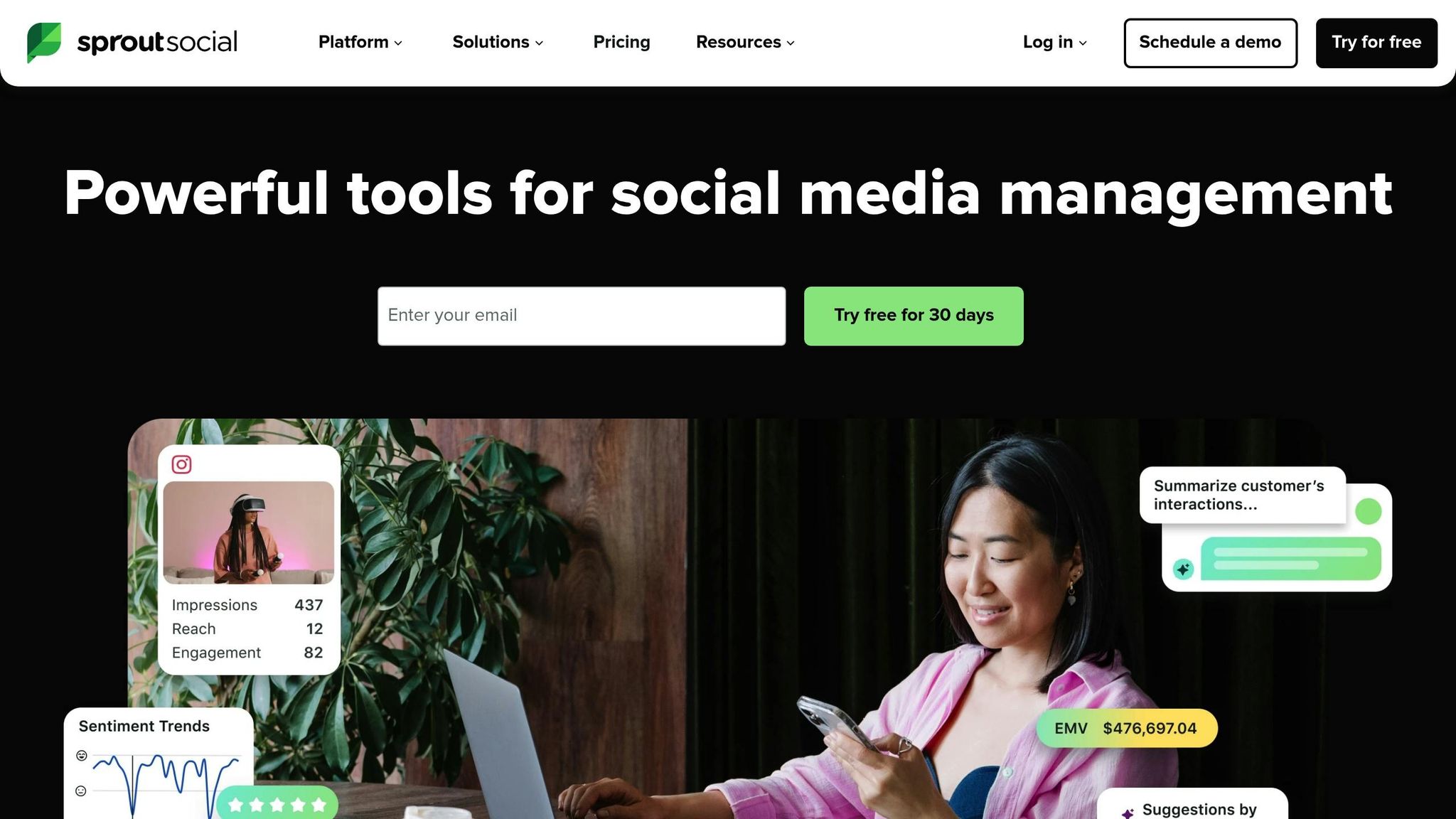
Sprout Social uses natural language processing (NLP) and machine learning to sift through millions of conversations in real time. Its Smart Inbox is particularly impressive – it prioritizes customer inquiries based on urgency and sentiment, ensuring critical issues or high-value questions are routed to the right team members. Why does this matter? Because a whopping 73% of consumers are likely to switch to a competitor if they experience slow responses on social media.
Bianca Shaw, Head of Social Media & Digital Reputation at Caesars Entertainment, shared her perspective:
"Managing a portfolio of brands as large as Caesars, repetitive content issues arise – so having the AI Assist functionality to generate variations is a great tool for workflow efficiency".
Sprout’s social listening tools also help brands stay ahead of fleeting trends, often lasting just 48 to 72 hours. For instance, Mastercard leverages this feature to track conversations and engage with relevant trends using pre-prepped posts and targeted ads. For those focused on ROI, Sprout has delivered a 268% return on investment over three years for a composite organization.
Buffer: Affordable Content Personalization
Buffer’s AI Assistant is designed to fine-tune content for each platform, adjusting tone, length, and style automatically. With pricing starting at just $5 per month per channel – and a free plan that supports up to three channels – Buffer is a budget-friendly option for businesses looking to dip their toes into AI-powered personalization.
While tools like Sprout Social and Buffer emphasize data insights and tailored content creation, other platforms take things a step further by optimizing campaigns on the fly.
Dynamic Yield: Real-Time Campaign Adjustments
Dynamic Yield focuses on real-time customization, using predictive analytics to tweak headlines, visuals, and calls-to-action (CTAs) as user behavior evolves. For example, it might swap out a discount code for a testimonial if that’s more likely to resonate with a specific audience.
This approach reflects a broader trend: 71% of social marketers now use AI automation in their workflows, and 82% report seeing positive results. However, maintaining a sense of authenticity is crucial. As Jeff MacDonald, Social Strategy Director at Mekanism, put it:
"AI is an ideal partner that continuously generates new ideas or takes a pass at that next brief for a client project you’ve been pushing off".
These platforms don’t just personalize content – they’re essential tools for building cohesive, effective brand strategies.
Examples of AI-Driven Social Media Campaigns
Brands are using AI in clever ways to create social media campaigns that deliver real, measurable results. Let’s look at a few standout examples that show how AI can turn personalization into business success.
Take Merkle’s "Magpie" AI tool as an example. This tool monitored top UK Twitter trends every hour, analyzed sentiment and topics using machine learning, and then crafted creative content and ad copy in real-time to target users across other channels. The results? A 33% increase in conversion rates, a 212% jump in total conversions, and a 51% drop in cost per conversion.
Similarly, Wowcher, a UK-based ecommerce company, used AI to create Facebook ads tailored to individual user interests, like travel deals. By ditching generic messaging and focusing on personalized content, Wowcher saw a 31% cut in cost per lead and a noticeable boost in relevancy scores.
Meanwhile, Mercedes-Benz Poland used AI to tap into emotions. By analyzing social media posts with keywords like #joy and #love, they gauged the public mood daily. The brand then adjusted the lighting on its headquarters and billboards in real-time to reflect the dominant sentiment, creating a unique connection between digital emotion and physical branding.
During the COVID-19 pandemic, Chipotle highlighted AI’s role in crisis management. By using sentiment analysis, they shifted their marketing focus to safety and connection. Their #ChipotleTogether campaign, featuring celebrity-hosted virtual lunch events, struck a chord with audiences looking for a sense of community during lockdowns.
Even shopping got a boost from AI. Sephora introduced AI-powered chatbots that guided customers through product recommendations via interactive quizzes. These bots turned the overwhelming task of choosing from countless products into a personalized, hassle-free experience.
These examples show how AI doesn’t just make campaigns more efficient – it helps brands create experiences that feel personal and relevant, setting a strong example for integrating these tools into broader strategies.
Combining AI with Brand Strategy for Better Results
AI tools are great at crunching data and automating repetitive tasks, but their real power shines when paired with a clear brand strategy. The companies that see the most success treat AI as a support system for their overarching brand goals. This starts by defining specific objectives – whether it’s increasing engagement, cutting ad costs, or building stronger customer loyalty – and then selecting AI tools that directly align with those goals. This blend allows businesses to use AI effectively within real-world brand strategies.
While 88% of marketers use AI to personalize customer experiences, the most impactful results come when companies adopt a "human-in-the-loop" philosophy (mentioned earlier). Kelly Moser, Co-founder of Home & Jet, explains it perfectly:
"The sweet spot is balance: use technology to make your job easier, but let real human insight and warmth guide the message".
This balanced approach lets AI handle tasks like scheduling, audience segmentation, and performance tracking, while human oversight ensures the creative direction stays true to the brand’s voice and remains relevant to current events.
Take Domino’s, for example. In 2025, they partnered with Emplifi to use AI-driven social care for routing customer conversations across platforms. However, they didn’t hand over everything to bots. By keeping a human touch in every interaction, they turned customer service moments into opportunities to build their brand. Similarly, Delta Air Lines used AI to manage millions of social media interactions, tailoring responses based on real-time factors like flight status or airport location. This approach transformed their social channels into powerful tools for fostering customer loyalty.
To achieve this balance, many businesses are turning to experts for help. With 34% of companies citing limited AI skills as a major obstacle to adoption, specialized partners can bridge the gap between AI capabilities and brand identity. For instance, firms like Dreamtown Creative provide tailored solutions, helping brands audit their existing data systems, create AI playbooks with brand-specific prompts, and maintain consistency across channels. These partnerships ensure that AI enhances the brand rather than diluting it, streamlining operations while strengthening the brand’s voice and presence.
The numbers back this up: fast-growing companies generate 40% more revenue from personalization than slower competitors. Additionally, businesses that fully embrace AI-driven personalization strategies have reported sales increases of 10% or more. These figures highlight that aligning AI tools with a well-defined brand strategy doesn’t just boost efficiency – it also drives authenticity and revenue at the same time.
Future Trends in AI and Social Media Personalization
AI’s role in shaping social media is evolving rapidly, with new trends promising deeper personalization and smarter content delivery. The focus is shifting toward technologies like multimodal learning, which processes video, audio, and text simultaneously. This approach allows platforms to better understand user intent and the context of content. For instance, Meta’s AI recommendation engine has already shown its impact, leading to a 24% increase in time spent on its platforms and boosting Reels watch time on Facebook by 15% through improved AI rankings. These advancements pave the way for more sophisticated tools, from fully automated campaigns to localized content tailored for diverse audiences.
Looking ahead, Meta has ambitious plans. By 2026, the company aims to create entire campaigns – including images, videos, and text – starting with just a single product image and budget. AI-driven localization tools, such as voice cloning and automatic dubbing, are also breaking down language barriers without the hefty costs of traditional translation. Meta’s NLLB-200 model, which supports 200 languages, already delivers translations with 44% greater accuracy than earlier systems.
Social platforms are also introducing AI-native conversational tools to transform how users interact with content. Features like TikTok’s Tako, X’s Grok, and Snapchat’s My AI encourage users to move from passive scrolling to active exploration. As AI strategist Alex Velinov puts it:
"AI is no longer just a supporting actor – it’s the lead".
These tools guide users through personalized content experiences, while generative AI features – such as real-time background editing, sticker creation, and image restyling through text prompts – boost engagement significantly.
The push for hyper-personalization is delivering measurable results. AI-powered content optimization achieves 83% higher engagement rates and outperforms manual posts for 72% of marketers. Businesses leveraging AI for ad optimization report a 20% increase in marketing ROI, and fast-growing companies see 40% more revenue from personalization compared to their slower counterparts.
Transparency is also becoming a priority, as platforms introduce mandatory labels like "Made with AI" and watermarks to comply with regulations such as California’s SB 942. Emily Kearns, Social Media Senior Manager at HubSpot, emphasizes the value of AI in content creation:
"AI has become an invaluable tool for content creation in the social space. It allows us to be more efficient and think through angles we might have otherwise missed".
Conclusion
AI-driven personalization has become a must for any social media strategy aiming to stay competitive. In today’s crowded digital world, generic content simply fades into the background. With 80% of consumers more likely to purchase from brands that offer personalized experiences, tailoring content is no longer optional – it’s a game-changer.
Brands leveraging AI for personalization report impressive results, including up to 40% more engagement and 25% higher conversion rates. As Nikhil Wad, Founder of Social Media Growth Guide, explains:
"AI-powered personalization isn’t just a nice-to-have anymore. It’s the difference between brands that thrive and those that barely survive".
These numbers highlight the direct link between personalization and stronger engagement, as well as better conversion outcomes.
The secret to success lies in combining AI with human creativity. AI excels at processing data, but humans bring the emotional intelligence and creativity needed to connect with audiences. Kelly Moser, Co-founder of Home & Jet, sums it up well:
"The best results come when AI handles the data and humans handle the connection".
This partnership allows marketing teams to focus on strategy and creativity while letting AI handle repetitive tasks, ensuring authenticity at scale.
To make the most of AI’s potential, take a phased approach. Start small – choose one tool, one platform, and one audience segment before expanding. Prioritize meaningful metrics like engagement quality and conversion rates over superficial numbers. Be transparent about how customer data is used, and always have a human review AI-generated content. Brands that strike the right balance between automation and human touch will rise above the noise in today’s crowded digital space.
FAQs
How does AI ensure personalized social media experiences while protecting user privacy?
AI manages to strike a balance between personalization and privacy on social media by focusing on two critical aspects: giving users control and ensuring transparency around data usage. Many platforms let users decide what information they want to share and even allow them to opt out of specific features. This approach helps maintain a customized experience while respecting individual boundaries.
Another way AI protects privacy is through data anonymization. By masking personal details, platforms can still deliver relevant content without compromising user identities. Add to that clear privacy policies and ethical guidelines, and you’ve got a system designed to build trust – helping users feel secure as they enjoy personalized interactions.
What are the main advantages of using AI for targeting social media ads?
AI brings major benefits to social media ad targeting by improving personalization and ensuring ads align more closely with individual user interests. This can result in higher engagement and stronger campaign results.
On top of that, AI processes vast amounts of user data to uncover patterns and preferences. With this insight, businesses can serve customized content that truly connects with their audience. The result? Greater efficiency and a better return on investment, as ads are delivered to the right people at the right moment.
How can brands use AI for personalization without losing authenticity?
To make the most of AI for personalization while keeping things real, brands need to combine AI-powered insights with a strong human element. AI is great at analyzing user behavior and suggesting customized content, but it’s essential for brands to step in and fine-tune the results. This ensures the content stays true to their voice and values.
Being upfront is important too – let your audience know when AI is part of the process. This kind of honesty helps build trust and deepens the relationship with your customers. When AI’s strengths are paired with human creativity and oversight, brands can create tailored, meaningful content that connects with people and inspires loyalty.