
5 Steps to Define Brand Voice

Your brand voice defines how your business communicates and connects with its audience. A clear, consistent voice builds trust, strengthens identity, and ensures your brand stands out. But crafting this voice requires intentional effort. Here’s a quick guide to the 5 steps:
- Understand Your Audience: Research who they are, what they value, and how they communicate. Review your current content for inconsistencies.
- Define Core Values: Align your voice with your company’s mission, vision, and values. Use exercises like "We’re This, Not That" to clarify boundaries.
- Set Voice Characteristics: Choose 3–5 attributes (e.g., friendly, professional) and decide on formality, emotional tone, and technical depth.
- Create Voice Guidelines: Document everything in a concise guide, including do’s, don’ts, and sample messages for different scenarios.
- Train and Monitor: Teach your team, review content regularly, and assign someone to maintain standards.
Consistency matters. Research shows it can boost revenue by up to 33% and foster trust with 90% of customers. Ready to refine your brand voice? Let’s dive in.
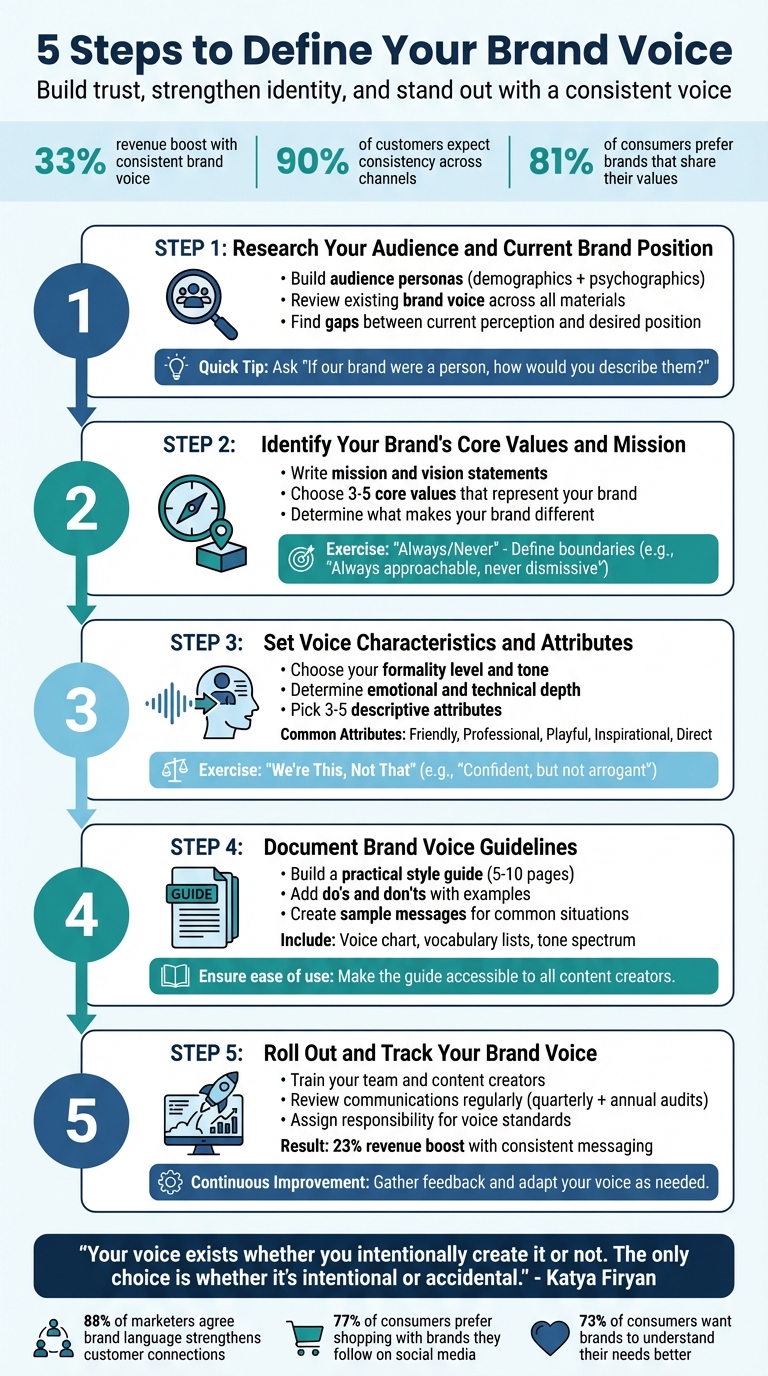
5 Steps to Define Your Brand Voice – Complete Process Guide
Step 1: Research Your Audience and Current Brand Position
Before shaping your brand’s voice, it’s crucial to nail down two things: who you’re speaking to and how your brand is currently perceived. This research sets the stage for everything else – giving you a clear view of your audience’s needs and how your brand stacks up right now.
At Dreamtown Creative, we emphasize the importance of truly knowing your audience. It’s the first step toward creating a voice that feels genuine and connects.
Build Audience Personas
Start by gathering two key types of data about your audience: demographics (like age, location, and income) and psychographics (their values, interests, lifestyles, and challenges). While demographics tell you who they are, psychographics dig into why they make decisions – which is the key to speaking their language.
Dive into where your audience spends their time online and how they communicate. Study their social media habits, writing style, and even the tone of the content they engage with. Are they all about casual slang, or do they lean toward industry-specific terminology? Do they like quick, snappy reads or detailed, in-depth explanations? The goal isn’t to copy them but to align your tone with what feels natural to them.
Think about the kind of relationship you want to build. Are you aiming to be a trusted expert, a friendly guide, or perhaps a peer who "gets it"? This matters because 81% of consumers are more likely to buy from brands that share their values.
Once you’ve nailed down your audience’s communication style, take a hard look at your current content. Are there inconsistencies in tone or messaging that might be causing confusion?
Review Your Existing Brand Voice
Start by creating a list of all your marketing materials – website copy, blog posts, social media updates, email campaigns, and ads. Then, label each piece with descriptors like "formal", "casual", or "technical." This will help you spot inconsistencies. For instance, does your website sound professional while your Instagram feels laid-back? If so, that mismatch could be sending mixed signals to your audience.
Next, analyze what’s working by looking at performance metrics like organic traffic, conversions, or engagement rates. For example, if your conversational blog posts are shared more often than your technical ones, that’s a sign of what resonates with your audience. Numbers like these can guide you toward a voice that clicks with your customers.
Don’t stop there – ask for direct feedback. Surveys and interviews with your existing customers can uncover how they perceive your brand. One interesting question to ask is: If our brand were a person, how would you describe them? This can reveal whether customers see you as more "corporate" or "approachable", giving you valuable insight into their perspective.
Find Gaps Between Current Perception and Desired Position
Now it’s time to compare your findings. Take what you’ve learned from customer feedback and performance data and match it against your internal goals. Talk to leadership to ensure their vision aligns with how customers experience the brand. It’s not uncommon to find a disconnect here.
To clarify your brand’s tone, try the "We’re This, Not That" exercise. For instance, complete phrases like "We’re confident, but not arrogant" or "We’re playful, but not silly." This can help you define the boundaries of your voice. If customers currently see your brand as distant and overly technical, but you want to come across as knowledgeable yet approachable, you’ve identified a gap to address.
Finally, use social listening tools to monitor how people talk about your brand on social media. Look for recurring words or themes in reviews, comments, and mentions. For example, if people often describe your brand as "helpful" but rarely mention "innovative" – and innovation is a core part of your identity – you’ve found another area to work on. Considering that 77% of consumers prefer shopping with brands they follow on social media, this step is especially important for staying in tune with your audience’s perception.
Step 2: Identify Your Brand’s Core Values and Mission
After understanding your audience and assessing your current brand position, the next step is to ground your brand voice in what your company genuinely represents. Your voice shouldn’t just sound appealing – it needs to reflect your true identity. Why? Because being genuine fosters trust and builds consumer loyalty. At Dreamtown Creative, we emphasize that staying true to your mission and values is key to creating a brand that truly connects with people.
Your mission, vision, and core values act as the foundation for maintaining a consistent voice across all platforms, whether it’s a social media post or a detailed privacy policy. With these basics in place, defining your mission and values becomes a crucial step.
Write Your Mission and Vision Statements
A mission statement explains your company’s purpose and who it serves, while a vision statement describes what you aim to achieve in the future. Together, these serve as a compass for your communication and ensure your voice stays consistent.
Start by documenting your company’s origins. Why does your business exist? How does it improve people’s lives? For example, Mailchimp’s mission focuses on helping small businesses succeed, which naturally leads to a warm, approachable, and helpful tone. Nike’s mission, summed up in "Just Do It", inspires boldness, passion, and urgency in its messaging.
If you haven’t already outlined your mission and vision, now’s the time to do it. A clearly defined mission helps ensure consistency – and consistency is something 90% of customers expect from brands.
Once you’ve established these guiding statements, you can refine your identity further by identifying core values that influence every decision your brand makes.
Choose Core Values That Represent Your Brand
Core values are the principles that guide your business and set you apart from competitors. Choose 3–5 values that reflect your brand’s personality – think traits like "witty", "earnest", or "curious".
One way to define these values is through the "Always/Never" exercise. For example: "We are always approachable, never dismissive". This method ensures your messaging stays aligned with your values – helpful without being overbearing or direct without being harsh.
Consider creating a simple cheat sheet or acronym for your team to remember easily. Additionally, review your current messaging, including website copy, social media posts, and emails, to ensure your voice aligns with the values you’ve chosen.
Determine What Makes Your Brand Different
Your brand voice should also emphasize what makes you stand out. According to research, 33% of consumers say a distinct personality is what makes a brand memorable. If your voice blends in with the rest of your industry, you risk being overlooked.
Think about what sets your brand apart – whether it’s your creativity, expertise, or ability to solve problems – and let that shine through in your tone. For instance, Apple’s confident, straightforward voice mirrors its philosophy of "innovation without confusion". Meanwhile, Mailchimp’s playful and quirky tone makes technical email marketing feel accessible and fun for small businesses.
"A brand voice isn’t just about sounding good; it’s about being unmistakable, undeniable, and impossible to ignore."
- Jason Vaught, Director of Content & Marketing, SmashBrand
To fine-tune your tone, try the "We’re This, Not That" exercise. Complete phrases like "We’re confident, but not arrogant" or "We’re witty, but not sarcastic". This technique helps clarify your voice’s boundaries and ensures it reflects your authentic identity – not an exaggerated version that feels disconnected. It’s worth the effort – 88% of marketers agree that brand language strengthens customer connections.
These elements will lay the groundwork for defining your specific voice characteristics in Step 3.
Step 3: Set Voice Characteristics and Attributes
Now that you’ve nailed down your brand strategy, mission, and values, it’s time to figure out how your brand actually sounds. Using your audience research and core values as a foundation, this step focuses on defining your tone – things like how formal, emotional, or technical your voice should be. From there, you’ll identify a few key words that sum up your personality.
Choose Your Formality Level and Tone
Formality is a key part of your brand voice, ranging from very formal to super casual. Where you land on this spectrum depends on your brand’s personality, your audience, and the platform you’re communicating on.
For example, formal language works well in industries like finance or healthcare, where professionalism and trust are critical. A financial company might say, "An error has occurred. We apologize for the inconvenience." Meanwhile, a casual consumer brand could go with, "Oops! Something went wrong – so sorry about that!"
To figure out what fits, take a close look at your audience’s demographics and online behavior. A helpful exercise is to ask, "If our brand were a person, how would they talk at a dinner party?" Would they be the knowledgeable expert, or the friendly, relatable guest? This can help you decide whether your tone should lean more professional or conversational.
Keep in mind, your core voice should stay consistent, but your tone can adjust depending on the context. You might use a polished tone on LinkedIn but take a more relaxed approach on Instagram. Research backs this up: 90% of customers expect the same experience across all channels, and 66% want brands to understand their needs.
Determine Emotional and Technical Depth
Next, think about how much emotion and technical detail to include in your messaging.
Emotional depth is about how strongly you express feelings. For example, a lifestyle brand might use enthusiastic, uplifting language to inspire its audience, while a legal firm might take a calm and reassuring tone to build trust. Matching your emotional tone to your audience and the situation is key – a cheerful tone might work for a product launch, but a more compassionate approach is better during a crisis.
Technical depth involves deciding how much industry knowledge you assume your audience has. A B2B software company targeting IT pros might use technical jargon confidently, while a consumer-focused app should stick to simple, everyday language. Tools like empathy maps or reviewing your top-performing content can help fine-tune both emotional and technical aspects. According to Nielsen Norman Group, users tend to respond better to enthusiastic tones than to flat, emotionless ones.
With these decisions made, it’s time to distill your brand’s personality into a few clear descriptors.
Pick 3–5 Descriptive Attributes
Start by brainstorming 20–30 adjectives, then narrow it down to the 3–5 that best capture your brand.
A great way to do this is by personifying your brand. Is it a "wise old uncle", a "supportive best friend", or maybe a "bold innovator"? This exercise can uncover authentic traits. You can also group similar ideas into one attribute. For instance, "transparent", "honest", and "uncomplicated" might all fall under "Clear."
Here are some common attributes to consider:
- Friendly: Warm and approachable, like Mailchimp or Slack.
- Professional: Formal and authoritative, similar to IBM or Salesforce.
- Playful: Fun and witty, think Duolingo or Wendy’s.
- Inspirational: Motivational and empowering, like Nike or Apple.
- Direct: Straightforward and to the point, as seen with Dollar Shave Club.
Once you’ve chosen your attributes, define their boundaries using a "This, Not That" exercise. For example, "We’re confident, but not arrogant", or "We’re witty, but not snarky." To make it even clearer, create a voice chart for each attribute, outlining what to do and what to avoid. This will be a crucial part of your style guide.
Consistency in your brand voice pays off. Studies show it can boost revenue by up to 33%, and 81% of consumers are more likely to buy from brands that share their values. Taking the time to get this right is an investment that truly pays off.
With your attributes locked in, you’re ready to document them in a full style guide in Step 4.
Step 4: Document Brand Voice Guidelines
After defining your brand’s voice characteristics, it’s time to put everything into a written guide. A brand voice style guide serves as the go-to reference for maintaining consistency in your messaging. Without this documentation, even the most carefully crafted voice can stray over time, leading to mixed signals and confusion.
Build a Practical Style Guide
Keep your style guide short and useful – ideally between 5 and 10 pages. It should be a quick and accessible resource for anyone creating content.
Start by listing your 3–5 core voice pillars from Step 3. For each, include a short explanation of how it ties back to your brand’s mission and values. Then, outline your tone spectrum to show how your voice shifts depending on the context. For instance, you might use a professional tone on LinkedIn but adopt a more relaxed style on Instagram. Similarly, your tone might be serious during a crisis but cheerful for product launches.
Set clear language guidelines. Cover things like sentence length, use of contractions, active voice, and whether jargon is appropriate. Create a vocabulary list of preferred terms and phrases, along with a list of words to avoid. This helps ensure your messaging stays consistent and avoids any off-brand language. You can even use these rules to fine-tune AI writing tools for your brand.
"Tone of voice reflects your brand personality, helps you connect with your audience, and makes you different from the rest." – SEMrush
Consider including a one-page checklist summarizing the key points. This makes it easy for content creators to double-check their work before publishing.
Finally, add specific examples of what your voice looks like in action with clear do’s and don’ts.
Add Do’s and Don’ts
A list of do’s and don’ts builds on your style guide, offering a clear framework to follow. A voice chart is a great way to keep everyone aligned. This simple table outlines each voice trait, explains what it means, and provides actionable examples of what to do – and what to avoid.
For instance:
| Characteristic | We Are | We Are Not | Do | Don’t |
|---|---|---|---|---|
| Friendly | Warm, approachable | Overly casual, unprofessional | Use "Hey there!" or "Hi [Name]" | Use "Dear valued customer" |
| Expert | Knowledgeable, helpful | Condescending, jargon-heavy | Explain concepts in simple steps | Use complex industry acronyms |
| Honest | Direct, transparent | Harsh, insensitive | "We messed up, and we’re sorry." | "We apologize for any inconvenience." |
This approach ensures everyone understands how to stay on-brand. Brands with consistent voice guidelines are more likely to see increased visibility and revenue – up to 33% more, according to research. However, with 77% of brands struggling to maintain consistency, having a clear do’s and don’ts section is essential.
Create Sample Messages for Common Situations
Sample messages bring your guidelines to life. These examples demonstrate how your voice should sound in various real-world scenarios. Focus on high-frequency situations, such as customer support emails, social media posts, newsletters, or press statements. Each example should reflect the core attributes you identified earlier, while adapting to the context – like being empathetic in customer interactions or playful on social media.
Here’s an example of how to structure these samples:
| Scenario | Voice Attribute | We Say (On-Brand) | We Don’t Say (Off-Brand) | Reasoning |
|---|---|---|---|---|
| Customer Support | Casual & Personable | "I’m really sorry you had a bad experience. I’ve passed this to my colleague and will update you soon!" | "Your complaint has been received. A response will be provided within 2–5 business days." | To make the customer feel they’re speaking with a real person. |
| Social Media | Playful & Engaging | "We’re obsessed with this new look! 😍 What do you think?" | "The company is pleased to announce the release of its latest aesthetic collection." | Social channels thrive on a conversational tone to drive engagement. |
| Media/PR | Authoritative | "Our data-driven approach ensures maximum efficiency for global enterprises." | "We’re super stoked to help big companies do things way faster!" | Professional contexts require a tone that builds credibility. |
Use these examples as templates for your team. You can also show "before and after" revisions of off-brand content to demonstrate how to align messaging with your guidelines. Additionally, tailor your examples to different stages of the buyer’s journey – educational for early awareness, more direct for decision-making.
"A brand voice chart is not a set-it-and-forget-it tool. As your brand messaging evolves or new competitors come into your market, refresh it with new examples." – Erika Heald, Content Marketing Expert
Consistency matters. Research shows that 90% of customers are more likely to trust brands with consistent messaging, and 73% want brands to show a better understanding of their needs. Sample messages bridge the gap between theory and practice, making it easier for your team to stay on-brand.
Treat your style guide as a living document. Review and update it annually to reflect changes in your brand or market. Assign someone to oversee content reviews and ensure the guidelines are followed. With these steps in place, your brand voice will be ready to shine across all channels.
Step 5: Roll Out and Track Your Brand Voice
Now that you’ve documented your brand voice, it’s time to put it into action and keep tabs on how it’s working. Research shows that brands with consistent messaging can see up to a 23% boost in revenue.
Train Your Team and Content Creators
Every team – whether marketing, product, customer service, sales, or operations – needs to be on the same page when it comes to your brand voice. To make this happen, store your guidelines in an easily accessible platform, like a brand asset management system or design system.
Hold workshops that break down each section of the guidelines, using examples tailored to your industry. Follow these sessions with hands-on exercises where team members create sample content for platforms like social media, email, or help docs. Provide immediate feedback to help them fine-tune their approach. For customer-facing teams, role-playing exercises can be invaluable, giving sales and support reps a chance to practice using the brand’s tone and personality.
"Voice work equips people who already know how to write well to write in a specific way. It doesn’t create writers. It channels them." – Katya Firyan, Co-founder, Writitude
Make sure the guidelines are part of your onboarding process, so new hires, freelancers, or agency partners understand your voice before they start creating content. During content reviews, refer to specific parts of the guide to keep feedback objective. You can even introduce a weighted scoring rubric to measure how well content aligns with your brand voice.
Review Communications Regularly
Your brand voice isn’t static – it should evolve with your business and audience. Plan to review your brand voice document at least annually to refresh examples and ensure it aligns with any shifts in strategy or market trends. Additionally, use quarterly customer surveys to gather feedback on how they perceive your brand, and monitor social media to track audience sentiment.
Don’t forget to audit your existing content, including older materials like blog posts and landing pages, to ensure they still align with your voice. Build voice checks into your publishing workflow to catch inconsistencies before content goes live.
Assign Responsibility for Voice Standards
To keep your brand voice consistent, designate someone – a brand manager or content lead – as the point person for maintaining the guidelines. This individual should review all content before it’s published, audit older materials periodically, and update the guide as your brand evolves.
While the designated voice owner ensures consistency, it’s up to everyone involved in content creation to follow the guidelines. When working with freelancers or influencers, include your brand voice expectations in their contracts. Make sure your guidelines are embedded in your design systems and content style guides for easy access. Consistency is crucial – 90% of customers are more likely to trust brands with coherent messaging.
Conclusion
Defining your brand voice isn’t a one-and-done task – it’s a commitment that evolves over time and delivers real results. By following the five steps outlined earlier, you’ve laid a solid foundation to help your brand stand out, connect with customers, and build trust. Research shows that most consumers prefer brands that align with their values, and consistent messaging has been linked to significant revenue growth.
But the work doesn’t stop there. As your business grows and your audience shifts, your brand voice should adapt too. Regularly auditing your messaging, training your team, and assigning clear ownership ensures that every interaction – whether it’s through marketing, customer service, or social media – reflects a unified personality. This kind of consistency turns your brand into something instantly recognizable, even without a logo.
"Your voice exists whether you intentionally create it or not. The only choice you actually have is whether that voice is intentional or accidental." – Katya Firyan, Co-founder, Writitude
Take what you’ve learned and put it into action: document your voice attributes, train your team, and track how your audience responds. Over time, staying consistent builds familiarity and strengthens your brand’s authority. A clear voice isn’t just about sounding polished – it’s about fostering a genuine connection that stands out in a sea of generic messaging.
The brands that succeed are the ones that stay true to themselves. Make yours one of them.
If you’re ready to take your brand voice to the next level, Dreamtown Creative can help. With expertise in fractional brand strategy and creative content, we’ll ensure your voice stays consistent, impactful, and aligned with your goals. Let’s create something unforgettable together.
FAQs
How do I know if my brand voice is working?
To determine if your brand voice is hitting the mark, focus on consistency and recognition across every platform where your brand communicates. A well-defined voice helps your brand connect with people and stick in their minds.
Pay attention to how your audience engages with your content and what kind of feedback you receive. If your messaging resonates with your target audience and helps you stand out in a crowded market, you’re on the right track. Make it a habit to review how your content is performing to ensure your brand voice continues to align with your overall goals.
How do I keep my voice consistent across every channel?
To keep your brand voice consistent across every channel, start by developing clear, documented guidelines. These should outline your brand’s personality, tone, and style in detail. Focus on identifying 3-5 key traits that define your brand, and include examples to illustrate how these traits should come across in your messaging.
Make sure your team understands and follows these guidelines – training sessions can be a big help here. Consistency isn’t just about looking polished; it helps build trust, boosts recognition, and ensures your audience can identify your brand even without seeing your logo. Refer back to these guidelines often to ensure your messaging stays aligned across all platforms and teams.
What should I include in a brand voice style guide?
A brand voice style guide should cover several essential elements to ensure your communication feels consistent and aligned with your brand’s personality. These include:
- Key personality traits: Define the tone of your brand, whether it’s friendly, professional, witty, or approachable.
- Tone and style guidelines: Establish rules for consistency across all communication.
- Language and phrasing examples: Provide clear examples that reflect your brand’s voice.
- Context-specific instructions: Tailor guidance for different platforms or channels, like social media, emails, or customer service.
- Visual preferences: Include details like punctuation, emoji usage, or formatting preferences.
Together, these elements help create a unified and authentic voice that resonates with your audience.