Top Tools For Data-Driven Content Repurposing
Repurposing content isn’t just smart – it saves time, money, and effort. Instead of creating new material from scratch, you can transform your best-performing content into formats tailored for different platforms. With tools powered by analytics and AI, this process becomes faster and more efficient.
Here’s the key takeaway: Data-driven repurposing focuses on what’s already working. Analytics identify your top-performing content, while AI tools help you reformat and distribute it across platforms like YouTube, TikTok, LinkedIn, and more. For example, a single one-hour animated explainer video can generate 30+ short clips, or a podcast can be transcribed into blog posts or social media snippets in minutes.
Why It Works:
- Better Results: Focus on proven content that resonates with your audience.
- Targeted Reach: Tailor content to fit each platform’s style and user preferences.
- Cost Savings: Repurposing reduces production costs by up to 80%.
Tools That Help:
- Dreamtown Creative: Flexible branding and content repurposing services.
- Repurpose.io: Automates video distribution across platforms.
- Otter.ai: Transcribes audio into text for blogs or captions.
- Canva: Simplifies visual content creation and resizing.
- BuzzSumo: Tracks trending topics and audience engagement.
Pro Tip: Start with analytics tools like Google Analytics and BuzzSumo to find your top 100 performing pieces. Then, use AI-powered platforms to reformat and publish them efficiently. This approach not only maximizes your content’s impact but also boosts ROI while saving time.
Benefits of Using Data to Repurpose Content
Leveraging analytics to guide content repurposing offers several clear advantages. Here’s a closer look at three key benefits.
Better Content Performance
Data takes the guesswork out of content creation by spotlighting what’s already working. Tools like Google Analytics help identify pages that hold visitors’ attention, while platforms like BuzzSumo highlight topics that generate the most social shares. This means you can focus your efforts on "winning pieces" – content that has already struck a chord with your audience.
Consider this: 73% of B2B marketers track conversions as their top performance metric, with email engagement and website traffic following closely at 71% each. By analyzing these metrics, you can pinpoint which content drives tangible results, whether it’s newsletter signups, demo requests, or sales. Repurposing high-performing content allows you to build on proven successes rather than starting from scratch with untested ideas.
Data doesn’t just show what works – it also reveals how to refine your approach to align with audience preferences.
More Accurate Audience Targeting
Analytics provide a clear picture of how your audience interacts with content. For example, TikTok users favor quick, attention-grabbing hooks, while LinkedIn audiences engage more with professional insights and strong opinions. Data also highlights accessibility needs, such as the fact that many social media users watch videos without sound, making captions a must for engagement. Armed with these insights, you can adapt a single idea into formats tailored to different platforms – like turning a blog post into an Instagram carousel or breaking a webinar into short, shareable video clips.
Visual content plays a major role here, too. Research shows that images are 65% more memorable than text alone after three days. This makes visual formats a smart priority when repurposing written content, ensuring your message resonates across various audience segments and channels.
When content is both well-targeted and optimized, the financial benefits follow naturally.
Higher ROI
Repurposing content is a cost-effective alternative to creating everything from scratch. Compare these numbers: producing 20 original pieces costs around $10,000 (at $500 per piece), while creating two original pieces and repurposing them into 18 adaptations costs just $2,000 – a savings of 80%. The time savings are just as striking – what would take 10 hours for 20 original pieces can be done in 3.5 hours when focusing on repurposing.
"The content repurposing calculus is pretty simple: get the greatest reach from the fewest resources." – WordStream
Content marketing as a whole outperforms traditional advertising, generating three times more leads per dollar spent while costing 62% less. By zeroing in on high-quality, data-backed repurposing strategies, businesses can boost engagement by nearly 20%. The secret lies in using performance data to identify content that drives results and maximizing its reach across multiple platforms.
Top Tools for Data-Driven Content Repurposing
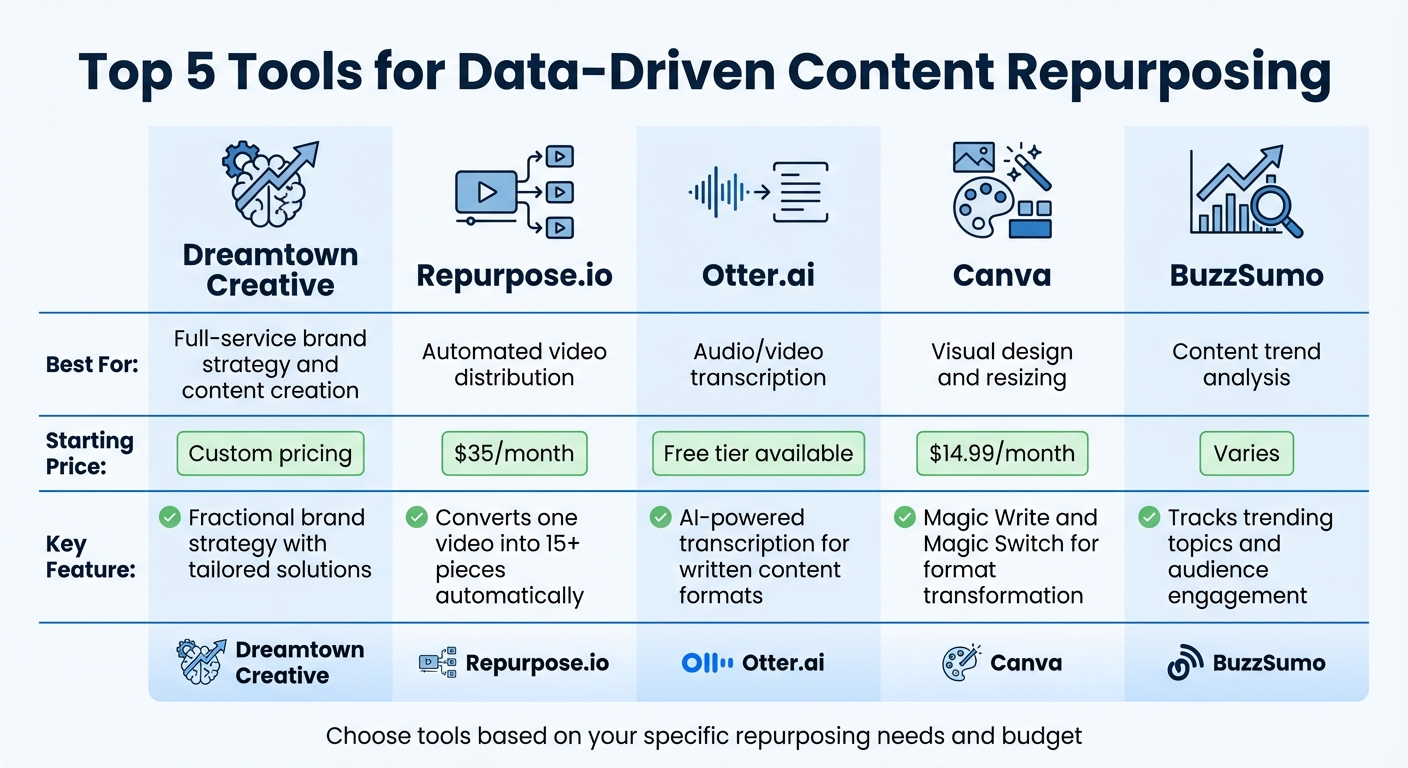
Data-Driven Content Repurposing: Top 5 Tools Comparison Chart
The right tools can completely change the way you handle content repurposing by streamlining tasks and providing data-driven insights. Here are five tools that can elevate your repurposing efforts:
Dreamtown Creative
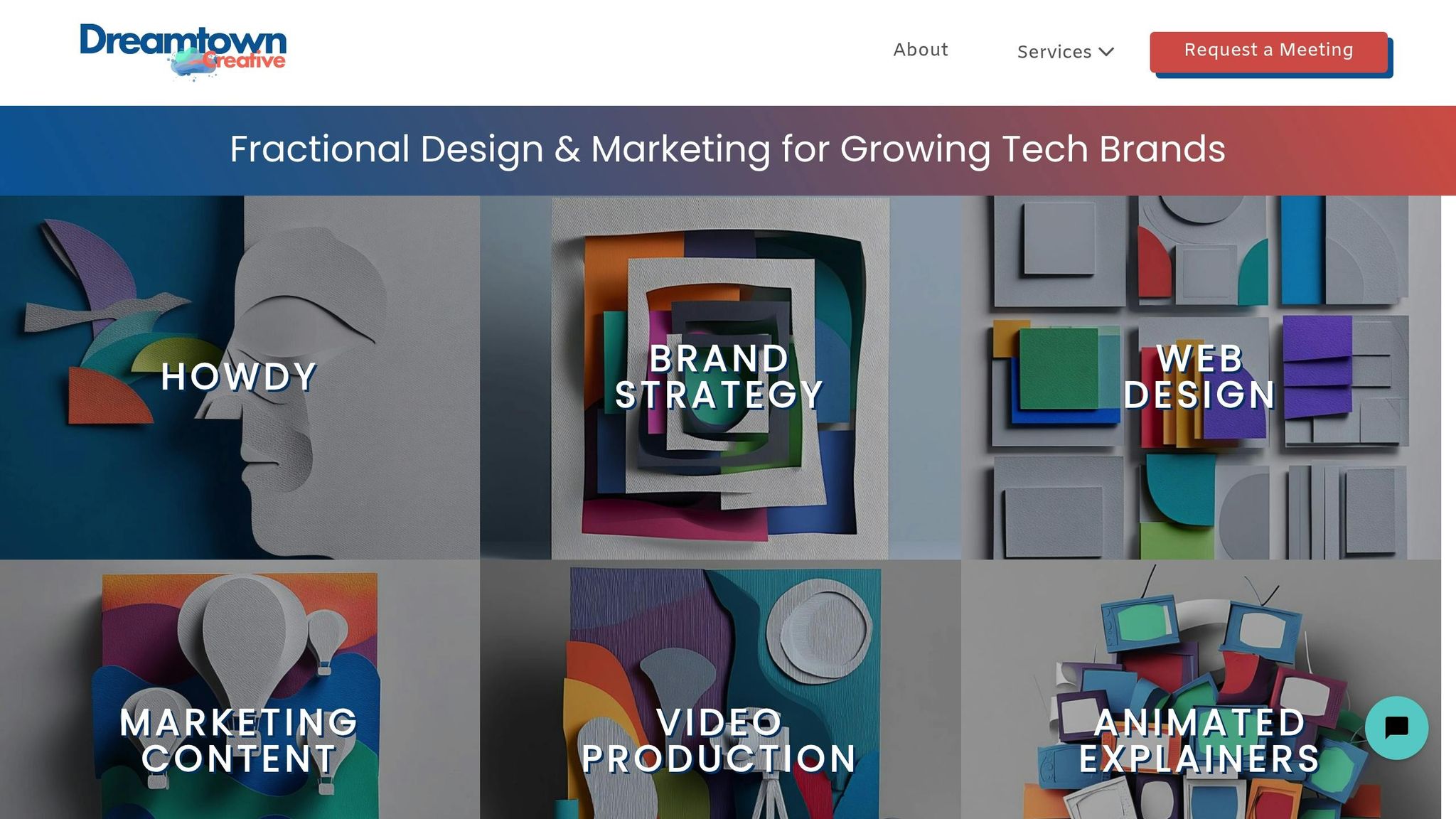
Dreamtown Creative specializes in providing flexible, expert branding solutions through a fractional brand strategy approach. They excel at crafting unified brand stories and adapting them into various formats like marketing campaigns, websites, corporate videos, and animated explainers. Businesses can choose from full-scale project packages, monthly design subscriptions, or individual services. This flexibility makes Dreamtown Creative a strong choice for companies seeking to align their content repurposing with their brand identity and market goals.
Repurpose.io
Repurpose.io takes the hassle out of content distribution by automating the process across multiple platforms. It can turn a single video into over 15 pieces of content and publish them directly to platforms like YouTube, TikTok, Instagram, Facebook, and LinkedIn – no manual uploads required. With over 650,000 users and 21.9 million videos repurposed, it’s a favorite among marketers who need a steady presence across various channels.
Digital Marketing Strategist Molly Mahoney shares her experience:
"Not only does it allow me to seamlessly turn one video into over 15 pieces of content, it will then publish the content automatically, saving me and my team hours every week".
Plans start at $35/month or $349/year (equivalent to $29/month), and there’s a 14-day trial with 10 free videos to test it out.
Otter.ai

Otter.ai is an AI-driven tool that transcribes and summarizes audio content into text. Whether it’s a webinar, podcast, or video meeting, Otter converts it into written formats like blog posts, social media snippets, or newsletters. This tool is especially handy for teams that regularly produce video or audio content, as it helps create SEO-friendly and accessible written versions tailored to different audience preferences.
Canva
Canva simplifies visual content creation with its AI-powered features. The Magic Write tool can take text and transform it into visuals, captions, and summaries, making it easy to adapt blog posts into Instagram carousels or slideshows. Meanwhile, the Magic Switch feature quickly resizes designs for different platforms, and the Brand Kit ensures consistency across all visuals. Canva’s free plan is great for basic needs, while Canva Pro starts at $14.99/month for more advanced options. It’s a go-to tool for visually adapting content across channels.
BuzzSumo
BuzzSumo helps you stay on top of trending topics, frequently asked questions, and audience engagement metrics by analyzing vast amounts of content from social platforms and the web. By identifying what’s already performing well, BuzzSumo makes it easier to repurpose content into formats that resonate with your audience. It’s a data-driven way to refine your strategy and focus on what works.
| Tool | Best For | Starting Price | Key Feature |
|---|---|---|---|
| Dreamtown Creative | Full-service brand strategy and content creation | Custom pricing | Fractional brand strategy with tailored solutions |
| Repurpose.io | Automated video distribution | $35/month | Converts one video into 15+ pieces automatically |
| Otter.ai | Audio/video transcription | Free tier available | AI-powered transcription for written content formats |
| Canva | Visual design and resizing | $14.99/month | Magic Write and Magic Switch for format transformation |
| BuzzSumo | Content trend analysis | Varies | Tracks trending topics and audience engagement |
These tools provide the foundation for a strong, data-informed approach to content repurposing, helping you save time while reaching wider audiences effectively.
How to Build a Data-Driven Content Repurposing Strategy
A successful content repurposing strategy isn’t about guesswork – it’s about using data to guide your decisions. By leveraging insights, adapting formats, and incorporating automation, you can maximize content reach while keeping efforts efficient.
Find Your High-Performing Content
Start by auditing your existing content to identify the pieces that perform best. Tools like Google Analytics 4 (GA4), Google Search Console (GSC), and BuzzSumo can help. In GA4, go to Reports > Life cycle > Engagement > Pages and screens to locate pages with the most views and highest average engagement time. Use URL filters like "/blog/" to focus specifically on blog content. In GSC, look for pages with strong backlink profiles, and check BuzzSumo to see which posts generated the most shares and social engagement. Aim to focus on your top 100 pieces that drive critical metrics like organic rankings and audience engagement.
Prioritize evergreen content – topics that stay relevant over time rather than fading in interest. These pieces are perfect candidates for repurposing.
Next, perform a ROT analysis to weed out content that’s Redundant, Outdated, or Trivial. Pieces flagged in this analysis may need updates or complete rewrites before being repurposed. Also, run a technical SEO audit to ensure the original content aligns with current standards for things like keyword usage, header structure, and alt text.
Adapt Content for New Formats and Audiences
Once you’ve identified your high-performing content, think about how to reimagine it for different formats and platforms. For example, a lengthy blog post could become multiple social media posts, an infographic, and even email segments. Keep in mind that each platform has its own style: YouTube thrives on detailed, structured content, TikTok loves quick, engaging hooks, LinkedIn rewards strong opinions, and Instagram shines with visual storytelling.
A useful method here is the content pyramid approach. Start with a cornerstone asset, like a webinar or whitepaper, and break it down into smaller pieces – social posts, email sequences, short-form videos, and more. For example, when turning a webinar into a blog, optimize it with on-page SEO techniques and keywords to boost its search visibility. Remember, visuals matter – a study shows that people retain 65% more information from images compared to text alone after three days.
While automation can help with repetitive tasks like resizing or text extraction, always include a human review to ensure your brand’s voice is consistent. Pages updated quarterly are 3x less likely to lose AI citations than those left untouched for longer periods.
Use Automation Tools
To make your strategy even more efficient, integrate automation into your workflow. For instance, set up systems where new posts automatically trigger tasks in tools like Trello or Asana. Platforms like Repurpose.io and Canva can handle much of the heavy lifting – Repurpose.io can turn a single video into 15+ assets and distribute them across platforms, while Canva’s Magic Resize feature adjusts designs for various channels with just a click.
Automation is becoming the norm, with 79% of businesses using marketing automation and 76% seeing positive ROI within a year. Automating tasks like social media management can save over 6 hours per week, and AI-driven tools can cut 3-4 hours from the time it takes to reformat a single blog post.
"Automation should enhance human creativity, not replace it." – ON24
Begin by addressing your biggest pain points – whether it’s converting videos to text or breaking blogs into social snippets. Start small with one specialized tool, then expand your tech stack as needed. Combining data insights, strategic adaptation, and automation can result in a system that delivers 3x more leads per dollar spent compared to traditional advertising, all while reducing costs by 62%.
Conclusion
Shifting from a "create once, publish once" mindset to a data-driven repurposing approach is a game-changer for maximizing content ROI. The numbers back it up: over 21,946,635 videos have been repurposed using automated platforms, and 90% of content marketers are gearing up to expand their use of AI tools by 2025.
AI tools take care of the heavy lifting – tasks like transcribing, clipping, resizing, and formatting – while your role ensures quality and consistency remain intact. This streamlined workflow makes it easier to conduct strategic audits and adapt your content effectively.
Start by auditing your content library with tools like Google Analytics or BuzzSumo to pinpoint your top-performing assets. Then, use a central tracking system to transform standout pieces into multiple variations tailored for different platforms.
As AITrendsTools puts it:
"The era of ‘create once, publish once’ is over. To succeed and scale in 2026, you must maximize the value of every single idea." – AITrendsTools
Looking ahead, predictive repurposing, hyper-personalization, and avatar cloning are poised to become central to content marketing strategies by 2026. The brands that thrive will be the ones that can take a single idea and turn it into a seamless, omnipresent brand experience. By relying on analytics to guide repurposing – from identifying high-performing content to selecting the right tools – you can transform your entire content creation strategy for the better.
FAQs
Which metrics should I use to pick content worth repurposing?
To figure out which content is worth repurposing, dive into metrics like page views and content performance data. These numbers show you what your audience has connected with the most, making it easier to pinpoint high-impact pieces that deserve a second life.
How can I repurpose one piece of content for TikTok, YouTube, and LinkedIn without losing my brand voice?
To make your content perform well across different platforms, it’s important to adapt to each platform’s unique style while staying true to your brand voice. For TikTok, focus on creating short, snappy clips that grab attention and connect emotionally. On YouTube, lean into longer, storytelling-driven videos that keep viewers engaged. When it comes to LinkedIn, aim for professional, thought-provoking content that positions you as a leader in your field.
While AI tools can help with formatting and efficiency, take the time to manually fine-tune the tone to match each platform’s audience. Use audience insights to make sure your message hits the mark, but always keep it genuine. Balancing these elements will help your content resonate without losing its authenticity.
What’s the simplest tool stack to start data-driven repurposing on a budget?
To kick off data-driven content repurposing without breaking the bank, consider using tools designed to simplify the process. RePurpose.ws can quickly turn long-form content into posts tailored for specific platforms. Trello is great for keeping workflows organized, while Otter.ai handles transcription tasks with ease. These budget-friendly (or even free) tools help you save time and extend your content’s reach effectively.