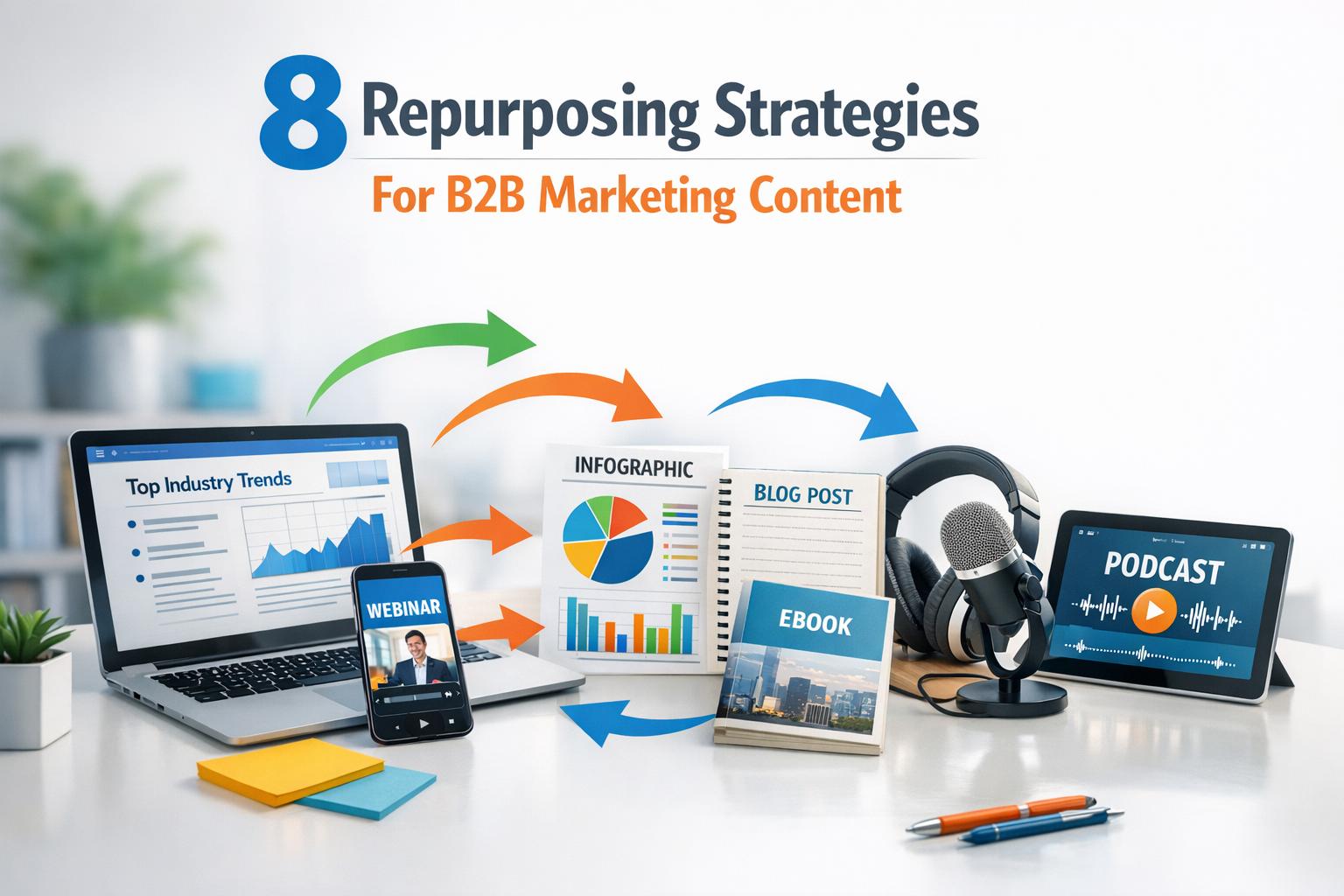
8 Repurposing Strategies For B2B Marketing Content
Creating a single piece of content like a whitepaper takes time, but using it only once wastes its full potential. Repurposing lets you break down long-form content into smaller, platform-specific pieces, helping you reach more people without starting from scratch. Here’s how you can do it:
- Break content into smaller pieces: Use the 5-to-1 rule – turn one report into five social posts, infographics, or videos.
- Create thread-style posts: Share key points in LinkedIn or Twitter threads for better engagement.
- Convert into multiple formats: Transform content into videos, podcasts, or email series to suit different preferences.
- Turn quotes into visuals: Highlight stats or insights with eye-catching graphics.
- Design reusable sections: Structure content into modular blocks for easier repurposing.
- Cut webinars into short clips: Extract 30–90 second videos for platforms like TikTok or LinkedIn.
- Use AI tools: Let AI summarize, extract, and reformat content faster.
- Feature customer success stories: Share testimonials as videos, posts, or blog snippets.
Repurposing not only saves time but also maximizes ROI by making your content work harder across multiple channels. Start with one piece and turn it into many.
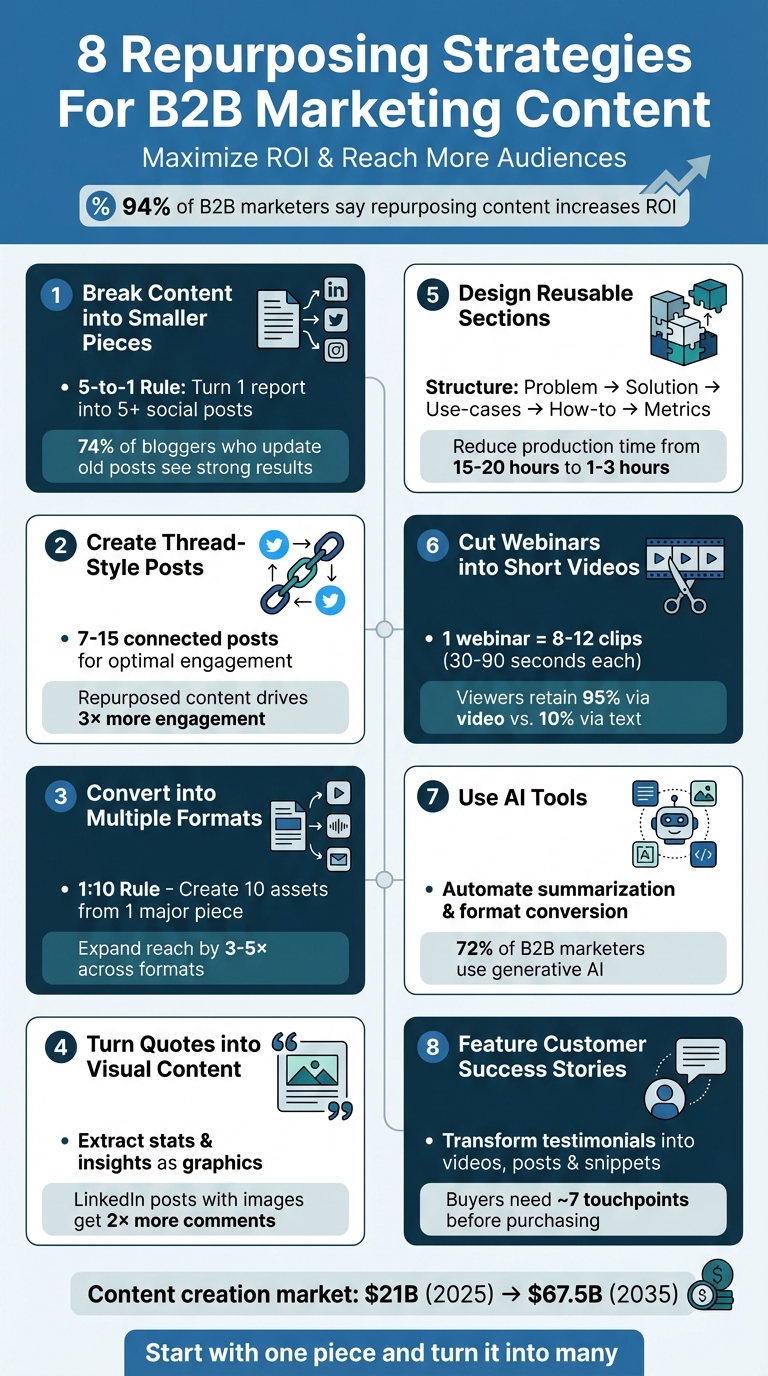
8 B2B Content Repurposing Strategies to Maximize ROI
1. Break Content into Smaller Pieces
Think of long-form content as a treasure trove of smaller, shareable pieces. Why? Because most readers only skim about 20% of the words on a typical web page during a single visit. That means your 5,000-word report has to work harder by being repurposed across multiple platforms and formats.
Here’s a handy approach: the 5-to-1 Rule. For every long-form asset, aim to create at least five pieces of social media content. For instance, if you’ve got a 30-page industry report, you could break it into:
- A LinkedIn carousel summarizing key findings
- An infographic showcasing the most important data
- A series of quote cards from expert interviews
- Several text posts that highlight individual statistics
Each piece can stand on its own while pointing readers back to the full resource. This way, your content reaches broader audiences and drives traffic to the original piece.
"I start thinking about repurposing opportunities from the moment I’m reviewing a content brief. It’s a strategic part of content creation, with an eye on lifecycle and future engagement." – Chima Mmeje, Senior Content Marketing Manager, Moz
Don’t overlook older content either. Refreshing outdated statistics, examples, or language can breathe new life into your archives. In fact, bloggers who update old posts are 74% more likely to see strong results, and doing so can cut content creation costs by up to 60%.
Finally, make sure each snippet fits its platform. For example, turn a webinar Q&A into a focused LinkedIn post, or transform data visualizations into eye-catching tweets. Including images works wonders too – LinkedIn posts with visuals get twice as many comments on average.
2. Create Thread-Style Posts
Threads are a fantastic way to break down dense reports into digestible, engaging snippets. Instead of just sharing a link and hoping people click, you deliver value directly in the feed. This not only builds trust but also nudges readers toward exploring your full resource. Think of it as tailoring your content to fit the platform while keeping your audience hooked.
Threads also breathe new life into your original content, extending its reach and boosting engagement. To make them work, structure is everything. Start with a strong hook – something like a bold claim, an eye-opening statistic, or a provocative question. Once you’ve grabbed attention, craft a narrative with a clear flow: a beginning to set the stage, a middle to share the main points, and an end that ties it all together. Aim for 7–15 connected posts to keep readers engaged without overwhelming them.
"Stop seeing your webinar as one asset. Think of it as a container with dozens of smaller, high-value assets. Your job is to find them, pull them out, and polish them." – RepurposeMyWebinar
The way you format your thread matters just as much as the content. Use short, punchy sentences and plenty of white space to make posts easy to skim, especially on mobile devices. Numbered emojis (like 1️⃣, 2️⃣) can help guide readers through your points. Enhance the text with visuals – short video clips or branded images – and always end with a clear call to action. Whether it’s asking a question to spark discussion, inviting people to follow, or linking to your full resource, make your next step obvious.
For example, a 60-minute webinar can inspire 5–8 unique thread ideas. Plus, repurposed content often drives up to 3× more engagement than sticking to a single platform. To get the most out of your threads, dig into your transcripts for standout moments – like surprising stats, bold opinions, or actionable tips that can stand on their own without extra context.
3. Convert Content into Multiple Formats
People consume content in all kinds of ways – some prefer watching videos, others enjoy listening to podcasts, and many start their day by checking emails. By converting long-form content into various formats, you can cater to these preferences and potentially expand your reach by 3–5x.
Here’s a stat to consider: 94% of B2B marketers say repurposing content increases ROI. For example, a single whitepaper can be repurposed into a 5-to-7-email drip sequence, delivering bite-sized insights over days or weeks. That same whitepaper could also become a 15-minute YouTube tutorial, structured around your blog headings, or even short, attention-grabbing TikTok or Reels clips (15–90 seconds) highlighting a striking stat. Want to cater to hands-free audiences? Turn it into an audio version. This kind of diversification ensures your content reaches more people without starting from scratch.
Interactive and visual formats – like infographics, slide decks, ROI calculators, or filterable charts – can also enhance engagement and keep users on your page longer. Meanwhile, native formats like LinkedIn articles or X threads help retain audiences on their favorite platforms. And for AI-powered tools like ChatGPT, structuring content as clear, concise FAQs can improve visibility.
"While you have to be careful with core pieces to make sure they have the expertise and first party perspective that can’t be replicated by AI, the work of repurposing into smaller pieces and microcontent… can be created using AI." – Chelsea Drusch, Strategist & SEO Manager, Weidert Group
The key is aligning formats with your audience’s habits. Podcasts are ideal for commuters and multitaskers, short videos grab mobile scrollers, and email series resonate with professionals glued to their inboxes. A smart way to approach this is by following the "1:10 Rule" – create at least 10 unique assets from every major content piece. This strategy can save up to 60% of your content creation time while significantly amplifying your reach.
4. Turn Quotes into Visual Content
Transforming key insights from whitepapers and reports into eye-catching visuals is a smart way to amplify your message. Why? Posts with images on LinkedIn, for instance, see twice the comment rate on average. Visual content grabs attention and encourages engagement.
The trick lies in knowing what to highlight. Look for hooks like surprising stats or relatable pain points that can stand alone without needing much context. For example, a stat like "94% of B2B marketers report that repurposing content extends its ROI" is perfect for a standalone graphic. Focus on quotes that demonstrate expertise or share original research, and keep the language snappy – ideal for quick social media consumption.
If design isn’t your forte, tools like Snappa can help you create professional-looking quote graphics in less than a minute with ready-made templates. Canva’s Bulk Create feature allows you to upload a list of quotes and generate dozens of social cards in one go. For automation, tools like Lately can extract shareable quotes directly from your content. Most of these platforms also offer brand kits, so your visuals align with your colors, fonts, and logos.
Maximize your efforts with the 5-to-1 rule: create at least five visual posts from every long-form piece of content. For example, you could turn a numbered list into step-by-step Instagram carousels, transform case study results into before-and-after graphics, or convert expert opinions into quote tiles. Each visual should include a call-to-action to drive traffic back to your original content. This approach can boost your reach by 3–5 times per creative hour.
At Dreamtown Creative, we specialize in turning detailed B2B reports into visuals that connect with audiences, helping your content go even further.
5. Design Content in Reusable Sections
Get more mileage out of your content by designing it with repurposing in mind. Instead of viewing a whitepaper or report as a single, static piece, think of it as a collection of modular blocks that can stand alone across various platforms. For example, a 4,000-word guide can be split into 5–15 smaller pieces – like key charts, quick how-tos, or specific insights – eliminating the need to start fresh every time. This modular approach makes repurposing easier and more efficient.
When creating long-form content, structure it around five key sections: problem, solution, use-cases, how-to, and metrics. Each of these sections can become its own asset. For instance:
- The "problem" section could be reworked into a compelling LinkedIn post.
- The "metrics" section might become an engaging infographic.
- The "how-to" section could be adapted into a short demo video.
By aligning these sections with specific formats, you streamline production and maximize the reach of your content.
To maintain consistency and save time, set up a "Source of Truth" document. This central repository should include all approved claims, statistics, and visuals from your main content. Teams using this approach have reported cutting production time significantly – from 15–20 hours to just 1–3 hours of review. For each section you plan to reuse, write a one-sentence summary and identify the best channels for distribution. This step ensures faster, more focused content distribution.
6. Cut Webinars into Short Videos
Repurposing webinars into short, engaging videos is a smart way to create fresh content for platforms like LinkedIn, Instagram, TikTok, and YouTube Shorts. A single hour-long webinar can be transformed into 8–12 standalone clips, each packed with value. The idea is to pull out moments that resonate on their own – like when a speaker tackles a common challenge, shares a key insight, or demonstrates a specific process. This approach not only extends the life of your content but also boosts engagement by delivering digestible, impactful snippets.
Start by reviewing the webinar transcript to pinpoint standout moments. Focus on Q&A segments that address real customer concerns, product demonstrations showing actual workflows, or impactful quotes from guest speakers. Since viewers retain 95% of a message when it’s delivered through video versus just 10% through text, these clips are far more engaging than written summaries. The goal is to ensure each clip provides value independently, without requiring the viewer to watch the full webinar.
Clip Length and Essentials
Keep your clips concise – 30 to 90 seconds for general use and 7 to 30 seconds for high-impact shorts. Each snippet should focus on a single takeaway, avoid unnecessary filler, and include captions (since over 80% of social video is viewed without sound). End each clip with a clear call-to-action, like "Watch the full webinar" or "Follow for more tips".
Streamlining the Process
AI tools like OpusClip and Chopcast can help you quickly identify the best moments by analyzing speaker energy and keywords, saving you hours of manual work. As Tommy F., Marketing Manager, shared:
"Before Chopcast, we had to take notes during our recordings of possible clips to extract… Chopcast took 99% of the manual labor out of extracting clips".
For a 20-minute webinar, aim to extract 6–10 clips to keep your content calendar well-stocked.
Formatting for Platforms
Once you’ve got your clips, format them for the platforms you’re targeting. LinkedIn performs best with square 1:1 videos (1080×1080), while vertical 9:16 formats (1080×1920) are ideal for Instagram Reels, TikTok, and YouTube Shorts. Modern editing tools can easily reframe horizontal webinar footage into these dimensions. To ensure brand consistency, use your brand’s colors and fonts in headers and subtitles so your clips are instantly recognizable.
7. Use AI Tools for Repurposing
AI tools can breathe new life into your content by transforming your long-form pieces into bite-sized, shareable microcontent. Instead of spending hours manually summarizing a 30-page whitepaper or transcribing a lengthy webinar, you can upload these assets into an AI system. In minutes, it can generate social posts, email snippets, and LinkedIn updates. The result? A streamlined process that turns your original content into multiple, targeted pieces. Think of your original content as your "Source of Truth" – a central reference point from which AI can create consistent, scalable content.
To take it a step further, leverage prompt engineering. Start with "System Prompts" to define your brand’s voice and tone, ensuring consistency across all outputs. Then, use "User Prompts" to specify exactly what you need. For instance, you might ask: "Create a 5-tweet thread summarizing the top three statistics" or "Write a 150-word LinkedIn post with bullet points". This dual-prompt approach ensures your brand identity stays intact while speeding up content creation. A great example is Modgility, a marketing firm that, in July 2025, used tools like Airtable and Make.com to connect source documents with AI models such as Claude 3.5 and GPT-4o. The result? They slashed their content creation time from 15–20 hours per week to just 1–3 hours of human oversight.
AI also excels at atomization, which involves breaking down a larger piece of content into smaller, platform-specific snippets. For example, a webinar Q&A session can be transformed into problem-solving posts for LinkedIn, while an interview transcript can yield quick insights for Twitter. Instead of summarizing an entire article, AI can extract a powerful quote or statistic that’s perfect for fast-scrolling feeds. As Chelsea Drusch, Strategist & SEO Manager at Weidert Group, puts it:
"While you have to be careful with core pieces to make sure they have the expertise… the work of repurposing into smaller pieces and microcontent to promote, expose, and amplify the main piece can be created using AI".
With 72% of B2B marketers now using generative AI in their workflows, and 65% agreeing that repurposing is more cost-effective than creating new content, these tools are proving their worth. Different AI models shine in different areas – Claude 3.5 Sonnet is great for summarization, while GPT-4o excels at crafting creative social copy. To maintain consistency, store your brand guidelines and platform-specific prompts in a central library. And, of course, always have a human review the final output to ensure accuracy before hitting publish.
8. Feature Customer Success Stories
Using customer success stories in whitepapers can be a powerful way to build trust with potential clients. But why stop there? Instead of keeping these testimonials buried in lengthy documents, turn them into engaging microcontent like animated explainer videos, LinkedIn posts, or blog articles. This approach resonates with B2B buyers who increasingly value authentic experiences and real voices over generic content. These firsthand accounts bring a level of expertise and credibility that AI simply can’t match.
To make the most of these stories, focus on key moments where customers discuss their challenges and measurable outcomes. For example, trim these testimonials into concise 7- to 30-second video clips. Format them for specific platforms – 1:1 for LinkedIn or 9:16 for TikTok, Instagram Reels, and YouTube Shorts. Since many users browse without sound, include auto-generated captions to ensure your message comes across clearly.
Keep the videos sharp and impactful by cutting filler words like "um" and "ah". Add a bold headline directly onto the video and use 3–5 relevant hashtags in the description to improve visibility and searchability. This repurposing strategy not only amplifies your message but also ensures it reaches your audience across multiple channels. Repetition is key – seeing the same success story in different formats builds familiarity and trust over time. A single customer testimonial can be transformed into a LinkedIn post, a short video, a blog section, or even an email snippet, allowing you to reach various stakeholders who prefer different content formats.
Go beyond video by sharing these authentic customer insights in online communities like Reddit or Quora, where buyers actively seek peer recommendations. You can also give your sales team an edge by equipping them with short clips and snippets from these stories for follow-ups and personalized account-based marketing conversations. With 94% of marketers already repurposing content to save time and maintain consistency, this approach is both efficient and effective.
Dreamtown Creative demonstrates how smart repurposing of customer success stories can extend your brand’s message across multiple platforms. By leveraging these stories in creative ways, you can keep your audience engaged and build trust with stakeholders across all your marketing channels.
Conclusion
Repurposing B2B content isn’t just a time-saver – it’s a smart way to connect with your audience on platforms they already use. In today’s marketing landscape, buyers often need to encounter your message around seven times before they’re ready to make a purchase. By breaking down larger assets like whitepapers, webinars, or reports into smaller, digestible pieces, you create multiple opportunities to engage them across different formats.
Here’s the reality: 94% of marketers repurpose content, and 58% directly link those efforts to revenue growth. Transforming long-form content into microcontent not only caters to shorter attention spans but also boosts your visibility on search engines. By targeting similar keywords across various assets, you signal to search engines that your brand is a trusted authority on the topic. And considering that most users only read about 20% of the words on a typical web page, microcontent becomes a powerful way to deliver concise and meaningful value.
To streamline this process, the PADR Framework stands out as a practical guide: create a Pillar piece as your foundation, Atomize it into formats tailored for different channels, Distribute content where your audience is most active, and Refresh it with updated insights over time. As Ross Simmonds, Founder of Foundation Marketing, aptly puts it:
"Create once. Distribute forever. Most people will spend 20 hours to create a masterpiece and spend 20 minutes to promote it".
For businesses looking to execute this strategy effectively, Dreamtown Creative offers specialized support in brand strategy, content creation, and video production. Whether you need a comprehensive package, a monthly design subscription, or project-based assistance, partnering with an agency ensures your repurposed content stays accurate and aligned with your brand’s voice. This shift from rigid publishing schedules to strategic, cornerstone-driven campaigns can help businesses achieve more impactful results.
With the content creation market projected to grow from $21.0 billion in 2025 to $67.5 billion by 2035, now is the time to master the art of repurposing. Doing so not only sets you apart in a competitive space but also ensures you’re maximizing the ROI of every piece of content, scaling efficiently, and maintaining consistent messaging across platforms.
FAQs
Which long-form asset should I repurpose first?
Start with a whitepaper or report. These types of content are packed with detailed insights and data, making them perfect for repurposing into smaller, bite-sized pieces of content. You can transform them into formats like social media posts, infographics, or blog snippets, all tailored to fit specific marketing campaigns.
How do I measure ROI from repurposed microcontent?
To gauge the return on investment (ROI) of your content efforts, focus on metrics that align with your specific goals. These could include engagement, lead generation, or conversion rates. Tools like Google Analytics or other performance tracking platforms can help you monitor how your content performs across various channels. Pay close attention to metrics like reach, interactions, and how your content influences the different stages of your sales funnel.
It’s crucial to set clear key performance indicators (KPIs) beforehand. Examples of KPIs might include website traffic, number of demo requests, or email sign-ups. Once your content has been live for a while, compare these results against the resources you’ve invested – whether it’s time, money, or both.
Make it a habit to regularly review these metrics. This not only helps you measure ROI effectively but also provides insights to tweak and improve your content strategy over time.
How can I use AI without losing our brand voice?
To integrate AI into your workflow while staying true to your brand voice, tailor AI prompts to mirror your specific tone, style, and messaging rules. This helps ensure that AI-generated content – like social media posts or email snippets – matches your brand’s identity. Combine AI’s speed with human oversight by reviewing and fine-tuning the results. This blend of automation and personal touch maintains consistency across channels without losing the essence of what makes your brand distinct.