
Why Austin Startups are Swapping Full-Time Executives for Fractional CMOs

Fractional CMOs are reshaping how Austin startups manage marketing leadership. Here’s why:
- Cost Savings: Full-time CMOs cost $600,000–$1.2M in the first year, while fractional CMOs cost $120,000–$300,000 annually.
- Faster Results: Fractional CMOs deliver results in 30–90 days versus 6–9 months for full-time hires.
- Flexibility: Their commitment scales with your needs, from 20+ hours per week during launches to just a few hours for oversight.
- Proven Impact: Companies see 4.5x more leads and 25–35% higher ROI with fractional CMOs.
For startups juggling tight budgets and growth demands, fractional CMOs offer high-level expertise without the risks and costs of full-time hires.
Full-Time vs. Fractional CMOs: Cost and Value Breakdown
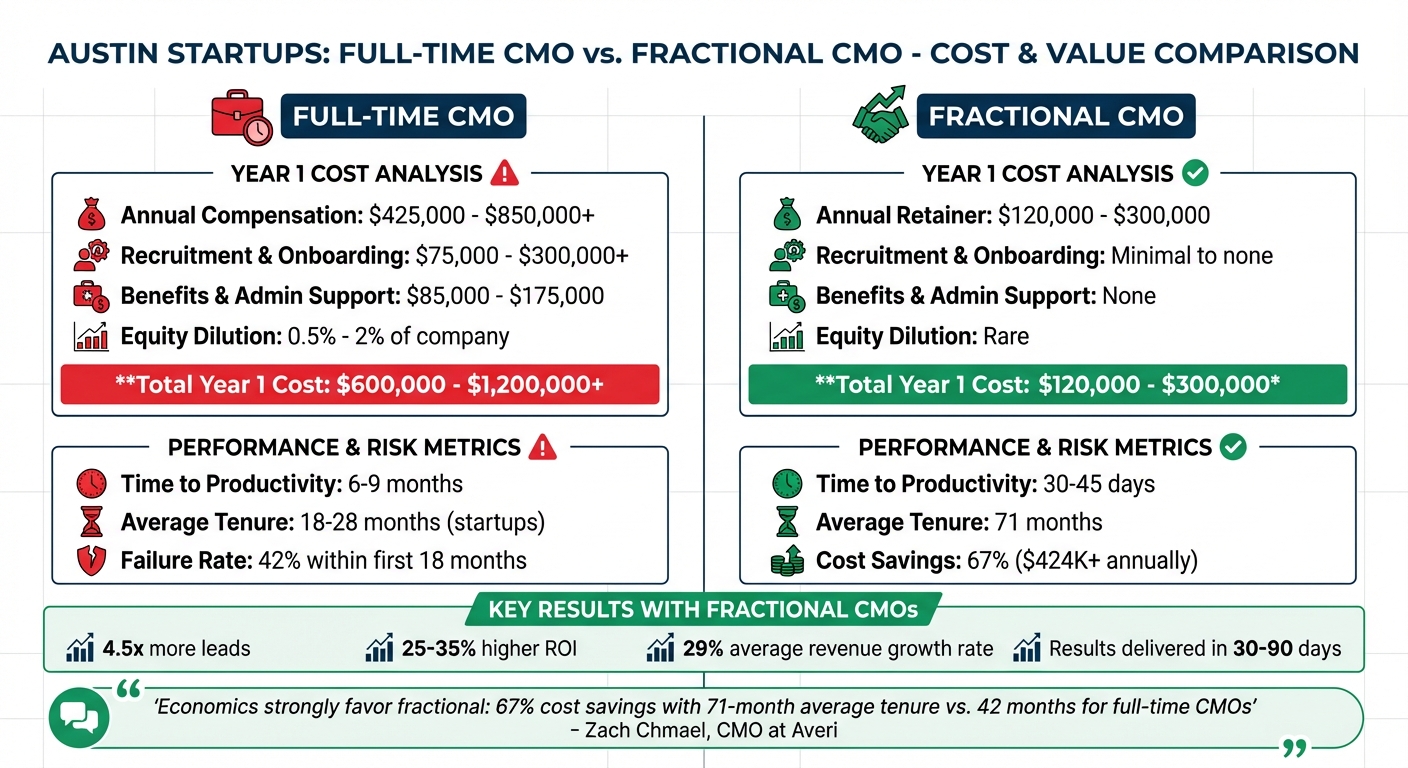
Full-Time vs Fractional CMO Cost Comparison for Austin Startups
What Full-Time CMOs Cost Austin Startups
Hiring a full-time Chief Marketing Officer (CMO) comes with a hefty price tag, especially in Austin’s competitive tech scene. Base salaries for CMOs generally fall between $200,000 and $500,000, but that’s just the beginning. These salaries make up only 60–70% of the total compensation package. When you add bonuses (25–50% of base salary), equity grants (0.5–2% of company stock), and benefits (ranging from $25,000 to $75,000 annually), the costs escalate quickly.
Then there are recruitment fees. Executive search firms typically charge 25–35% of the first-year compensation, which can mean an additional $75,000 to $300,000+ in fees. Onboarding costs can also sneak up on startups. These include expenses like hiring an Executive Assistant ($60,000–$100,000), relocation packages for candidates outside the Austin area ($50,000–$150,000), and professional development budgets ($10,000–$25,000).
When you add it all up, the first-year cost for a mid-market CMO ranges from $600,000 to $1,200,000. For startups that are mindful of their budgets, this is a huge financial commitment. What’s more, there’s risk involved – studies show that 42% of full-time CMOs fail within their first 18 months.
Now, let’s look at how fractional CMOs can provide a more economical solution.
Why Fractional CMOs Cost Less
Fractional CMOs operate on a monthly retainer model, which eliminates many of the costs tied to full-time executives. For early-stage startups in Austin (with $1M–$10M in revenue), retainers typically fall between $5,000 and $15,000 per month. Growth-stage companies (with $10M–$50M in revenue) usually pay $10,000 to $25,000 monthly. This means annual costs range from $60,000 to $300,000, a fraction of what full-time CMOs require.
The cost savings don’t stop there. Fractional CMOs don’t require recruitment fees, benefits packages, equity grants, or dedicated administrative support. This leaner cost structure allows startups to redirect funds toward critical initiatives like product development and customer acquisition. Another advantage? Fractional CMOs can hit the ground running, becoming productive within 30–45 days, compared to the 6–9 months it often takes full-time hires to ramp up.
As Zach Chmael, CMO at Averi, puts it:
"Economics strongly favor fractional: 67% cost savings ($424K+ annually) with 71-month average tenure vs. 42 months for full-time CMOs, while delivering 80% better performance outcomes."
Cost Comparison Table
| Cost Category | Full-Time CMO | Fractional CMO |
|---|---|---|
| Annual Compensation/Retainer | $425,000 – $850,000+ | $120,000 – $300,000 |
| Recruitment & Onboarding | $75,000 – $300,000+ | Minimal to none |
| Benefits & Admin Support | $85,000 – $175,000 | None |
| Equity Dilution | 0.5% – 2% of company | Rare |
| Total Year 1 Cost | $600,000 – $1,200,000+ | $120,000 – $300,000 |
| Time to Productivity | 6–9 months | 30–45 days |
| Average Tenure | 18–28 months (startups) | 71 months |
This side-by-side comparison highlights why fractional CMOs are a smart financial choice for startups in Austin. By opting for a fractional CMO, companies can access high-level marketing expertise without the steep costs and risks associated with full-time hires. Plus, the savings can be reinvested into growth-driving activities, giving startups a stronger footing in competitive markets.
Why Full-Time CMOs Don’t Work for Most Austin Startups
Hiring Too Early Creates Problems
Bringing in a full-time CMO too soon can create financial headaches for startups. Most early-stage companies don’t have a fully developed marketing team – ideally, at least 10 members – where a senior executive can operate effectively. Without this foundation, CMOs often get pulled into day-to-day tasks that don’t match their skill set or justify their high salaries. This misstep can drain resources, leaving little room for actual marketing efforts, while also requiring founders to give up 0.5% to 2.0% of company equity.
Jessica Grace, a Fractional CMO, explains it well:
"You wouldn’t hire a full-time architect before deciding what kind of house you’re building. Don’t hire a marketing team before you know what you stand for."
Long-Term Commitments Don’t Match Startup Needs
Startups in Austin are known for their agility, but long-term commitments can tie their hands. A full-time CMO represents a fixed and costly obligation, which can be tough to undo – especially considering that 42% of these hires fail within 18 months. When things don’t work out, severance costs alone can run as high as 6 to 12 months of salary. Combine that with an initial first-year investment of around $802,500, and the financial risk becomes clear.
Adding to the challenge, only 27% of CMOs feel their role is well understood internally, and by 2025, 73% of growing companies are expected to reevaluate their approach to permanent CMO roles. In contrast, fractional CMOs offer much more flexibility, with 30-day exit terms that allow startups to pivot without the heavy baggage [6, 13].
These factors highlight why long-term commitments to full-time CMOs often clash with the fast-moving nature of startups.
Administrative Burden of Full-Time Executives
Full-time CMOs also bring a significant administrative load. The recruitment process alone can take up to a year, delaying progress and eating up valuable time. Once hired, the ongoing administrative requirements – like onboarding and performance management – add further strain. Recruitment costs only compound the issue, pulling founders’ attention away from critical business activities.
Elad Itzkovitch, CEO of CMO’vate, sums it up:
"The first year of a full-time CMO can cost a company over $400,000 and a significant chunk of equity."
For resource-constrained Austin startups, which need to remain nimble, the administrative and financial demands of a full-time CMO often outweigh the benefits.
What Fractional CMOs Deliver for Startups
Senior-Level Marketing Strategy
Fractional CMOs provide high-level marketing expertise without the hefty price tag of a full-time executive. They help startups move beyond disorganized marketing efforts – where founders might be juggling social media, emails, and paid ads without a clear strategy – and implement a structured Marketing OS (Operating System). This includes documented processes and dashboards to keep everything on track.
Unlike traditional consultants who only offer advice, fractional CMOs take the reins. They define key elements like positioning, messaging, and budget allocation. Most engagements kick off with a "funnel CT scan" or audit, which typically lasts 1–3 weeks. This ensures analytics and attribution are accurate before ramping up marketing spend.
The impact is clear: startups working with fractional CMOs see an average revenue growth rate of 29%, compared to 19% for those without. One standout example is a long-term care SaaS company that partnered with fractional CMO Peter Murphy Lewis. By shifting from unproductive trade show appearances to launching an educational podcast called "LTC Heroes", the company achieved a 100x increase in lead volume. This strategy generated 15 sales-qualified leads per week and ultimately led to the company’s acquisition by a major industry player.
"A fractional CMO is not a part-time marketer. You are buying executive-level marketing leadership that delivers strategy, decision-making, measurement, and team alignment." – Kamyar Shah, Fractional CMO
Fractional CMOs also bridge the gap between sales and marketing teams by aligning them under shared KPIs. This eliminates inefficiencies and improves lead quality. Businesses hiring fractional CMOs report an average of 4.5x more leads, and marketing ROI often increases by 25–35% within a year when scattered tactics are replaced with a unified strategy.
As startups grow, these strategies naturally evolve, offering leadership that adjusts to the company’s changing needs.
Adjustable Involvement as You Grow
One of the standout advantages of fractional CMOs is their flexibility. They can dedicate significant time – 20–32 hours per week – during critical periods like product launches or funding rounds. Then, as your in-house team gains traction, they can scale back to just 4–8 hours per week for ongoing oversight.
This adaptable approach saves startups from the costs and risks tied to hiring a full-time executive, such as recruiting expenses, benefits, and severance.
"A full-time CMO is often built for scale stability. A fractional CMO is built for transition." – Vineet Arya, Founder, Cohiire
Typically, fractional CMOs require a commitment of at least 3–6 months. They usually spend the first 30 days conducting audits, 60 days aligning teams, and 90 days delivering measurable improvements in your sales pipeline. Unlike full-time hires, though, this arrangement doesn’t lock you into a long-term contract.
Industry-Specific Knowledge
Fractional CMOs bring more than just strategies – they offer deep industry knowledge tailored to your market. With experience in sectors like fintech, SaaS, and healthcare, they can apply proven tactics from one industry to another, creating fresh opportunities for growth. For example, they might adapt SaaS marketing techniques to help an e-commerce startup break new ground.
This expertise is especially valuable when preparing for investment rounds. Fractional CMOs refine your brand positioning and craft narratives that resonate with venture capitalists and strategic partners. They focus on resource-efficient strategies like growth hacking and A/B testing, steering clear of costly branding exercises.
Consider these results: FullProxy, a cybersecurity firm, saw 135% revenue growth and a 33% increase in website traffic after bringing on fractional marketing leadership. Similarly, Sanctuary Clothing, an e-commerce company, achieved a 4.2x return on ad spend across paid search and social campaigns, along with an 80% boost in organic traffic within a year.
"A fractional CMO will typically favor growth hacking techniques… over large, expensive branding exercises, ensuring every dollar spent drives results." – Jacob Sheldon, Marketplace Founder
For startups in competitive markets like Austin, the combination of executive-level expertise and industry-specific insights makes fractional CMOs a game-changer compared to generalist marketers.
Main Advantages of Fractional CMOs for Austin Startups
Fast Start, Quick Results
Hiring a fractional CMO eliminates the lengthy 4–6 month hiring process usually required for full-time executives. These professionals can pinpoint marketing gaps in just a few days. They bring tried-and-tested strategies from a variety of industries, allowing them to hit the ground running.
Most fractional CMO engagements follow a streamlined 90-day process: the first 1–3 weeks focus on assessment, weeks 3–8 involve planning and piloting, and the final phase emphasizes scaling and systemizing. This approach ensures startups begin seeing tangible improvements in their sales pipeline within the first three months.
"A fractional CMO often acts as the ‘growth architect’ before you pour concrete." – SOHO Creative Group
Take the case of Teamfluence, a SaaS startup. In January 2024, they were losing $40,000 per month with a churn rate of 68%. After bringing in a fractional CMO for $6,000 per month (working just 15 hours per week), the company slashed customer acquisition costs by 41% and reduced churn to 29% in just four months. This turnaround positioned them to secure a $5 million seed round.
Executive Expertise at Lower Cost
Fractional CMOs offer Austin startups access to senior-level marketing leadership without the high costs of a full-time hire. A full-time CMO typically costs between $250,000 and $500,000 annually when factoring in salary, bonuses, benefits, and equity. In contrast, fractional CMOs work on retainers ranging from $4,000 to $15,000 per month, delivering top-tier strategy without the hefty price tag.
The savings go beyond just salary. Fractional CMOs consistently deliver measurable results. For example, Unity Communications partnered with fractional marketing leaders in Austin from 2022 to 2024 and saw dramatic growth: a 481.14% increase in organic web traffic, 320% revenue growth, and an 18X boost in qualified leads. These gains were achieved without the financial commitment required for a full-time executive. Combined with these cost savings, their localized expertise helps drive region-specific growth.
Local Market Knowledge for Austin
Fractional CMOs bring more than just cost efficiency – they also provide invaluable local insight. Austin’s startup scene is fiercely competitive, particularly in sectors like HealthTech, FinTech, SaaS, and EdTech. Fractional CMOs with experience in the Austin market understand the unique buyer demographics and regulatory requirements specific to Texas industries. They also know how to leverage Austin’s key neighborhoods and business hubs for targeted market expansion, whether online or offline.
Austin buyers value clarity and speed, and local fractional CMOs are well-versed in these preferences. By tailoring messaging to meet these regional demands, they help startups stand out in crowded markets and gain traction faster.
"A fractional CMO is a C-suite marketing leader for Austin companies without the full-time cost. In a city shaped by rapid growth, tech migration, and evolving buyer expectations, a Fractional CMO brings high-level strategy… tailored to Austin’s pace." – Digital Authority Partners
Fractional CMOs in Austin have reportedly driven $250 million in revenue growth for over 30 Texas-based brands. Their expertise extends beyond the local market, helping startups transition from regional success to global recognition. This is particularly critical during fundraising rounds, where a fractional CMO’s ability to refine branding and craft compelling narratives can make a significant difference with venture capitalists familiar with Austin’s dynamic tech scene. Their combination of local expertise, cost efficiency, and agility makes them an essential asset for startups navigating Austin’s competitive landscape.
Conclusion
Austin startups face a clear choice: spend over $250,000 annually on a full-time CMO for long-term stability, or cut costs by about 40% with a fractional CMO focused on driving growth and momentum. Data shows that fractional CMOs deliver impressive results, generating 4.5 times more leads.
The real edge comes from aligning leadership to your company’s growth stage. If you’re pre-Series A or launching a new product, what you need is sharp strategy and agile execution – not the overhead or long-term commitment that comes with a full-time hire. Fractional CMOs bring executive-level expertise honed across industries, offering the strategic insight of seasoned leaders without locking you into a permanent role. This approach simplifies operations while fueling growth during critical phases.
"A full-time CMO is often built for scale stability. A fractional CMO is built for transition." – Vineet Arya, Founder, COHIRE
Beyond cost savings and leadership benefits, flexibility is a key advantage. During funding rounds, for example, a fractional CMO can ramp up their involvement to fine-tune investor positioning, then scale back once operations are steady. This model protects cash flow while ensuring you still have access to top-tier strategic guidance – something Austin’s competitive HealthTech, FinTech, and SaaS sectors demand.
Austin startups aren’t just jumping on a trend – they’re making smart, stage-appropriate decisions. By prioritizing traction over titles and results over résumés, they’re leveraging fractional CMOs to meet their evolving needs with cost-effectiveness, adaptability, and deep expertise.
FAQs
When should my Austin startup hire a fractional CMO?
If your Austin-based startup is at a stage where strategic marketing leadership is crucial, but bringing on a full-time executive feels too expensive or unnecessary, a fractional CMO could be the perfect solution. This approach is especially useful during pivotal growth phases, such as working toward product-market fit or gearing up for Series A funding.
The benefits? Fractional CMOs offer expert-level guidance while being flexible and budget-friendly. In fact, they can cost 40–65% less than hiring a full-time marketing executive. For early-stage companies focused on stretching their resources wisely, this makes a lot of sense.
What should I expect in the first 90 days with a fractional CMO?
In the first 90 days, a fractional CMO dives into your business to get a clear picture of how things work. They’ll assess your current marketing efforts, pinpoint areas that need improvement, and align strategies with your overall business goals. During this time, they’ll also focus on building strong relationships with your team and key stakeholders, ensuring everyone is on the same page.
You can expect some quick wins to kickstart progress, but the real focus is on setting up a solid foundation for long-term success. Establishing trust and credibility within the organization is a key part of this phase.
How do I measure if a fractional CMO is working?
To gauge how well a fractional CMO is performing, keep an eye on key performance indicators (KPIs) that tie directly to your business objectives. Pay attention to metrics such as pipeline coverage, customer acquisition cost (CAC) payback, conversion rates, sales velocity, and win rates. These metrics provide valuable insights into the health of your pipeline, revenue growth, and the return on investment (ROI) from marketing efforts. Tracking these ensures the fractional CMO’s work is aligned with your strategy and delivering measurable results.