Future Of Content Calendars In AI Marketing

AI is transforming how marketers manage content calendars. Instead of spending hours on manual planning, teams now rely on AI tools to handle repetitive tasks, predict trends, and provide data-driven insights. This shift is essential in 2025’s fast-paced marketing landscape, where businesses must keep up with informed buyers and increasing competition.
Here’s what you need to know:
- 94.1% of marketers have adopted AI in the past three years, and 60.4% actively use it today.
- AI tools like Morpheus, Copy.ai, BuzzSumo, and Flick simplify content creation, trend analysis, and performance tracking.
- Each tool has specific strengths: Morpheus excels in predictive analytics, Copy.ai helps with quick content generation, BuzzSumo focuses on research and SEO, and Flick optimizes social media engagement.
1. Morpheus
Morpheus is an AI-driven marketing analytics platform designed to simplify and enhance content calendar management. It doesn’t just schedule posts – it also analyzes your marketing efforts to predict their effectiveness.
The platform shines in three key areas that directly influence how you plan and execute your content calendar. It provides real-time insights to track campaign performance, leverages predictive analytics to anticipate future trends, and offers custom dashboards that bring together data from all your marketing channels – both online and offline. These features make it a powerful tool for marketers looking to stay ahead of the game.
Predictive Analytics
Most tools rely heavily on historical data, but Morpheus goes a step further. By identifying patterns, it predicts which content strategies are most likely to succeed. This forward-thinking capability allows marketing teams to make proactive, data-driven decisions about content formats, topics, and publishing schedules. For example, if the analytics suggest that video content will dominate over blog posts in your industry during Q2 2025, you can adjust your plans and allocate more resources to video production well in advance.
Morpheus doesn’t just help you plan – it helps you avoid pitfalls. By detecting potential challenges and opportunities before you publish, it enables teams to optimize budgets and refine strategies. As consumer behaviors shift, its analytics can highlight these changes early, helping you adapt quickly and stay aligned with market trends.
Integration Capabilities
Morpheus isn’t just about predictions – it’s also built for seamless integration. The platform consolidates data from social media, email campaigns, websites, and even offline events into a single, unified dashboard. This holistic view eliminates the need for fragmented reporting and ensures that all parts of your marketing team – whether it’s social media managers, content creators, or email marketers – are working toward shared goals.
2. Copy.ai
Copy.ai has grown into an AI-driven Go-to-Market (GTM) platform that does more than just generate content. It simplifies content calendar management by bringing together various tools and marketing workflows under one roof. At the heart of this evolution is a unified data system that pulls information from multiple sources, automating tasks that previously required time-consuming manual effort.
Integration Capabilities
With support for over 2,000 integrations, Copy.ai connects tools like CRM systems, social media analytics, and website metrics seamlessly. Instead of basic, one-way data transfers, it links these systems to provide marketers with consolidated insights and smoother operations.
Roman Olney, Head of Global Digital Experience at Lenovo, shared how this integration has made a difference:
"Copy.ai has been phenomenal in transforming the way we develop marketing content. By automating weeks-long workflows and reducing high agency costs, they’ve saved us $16 million this year alone."
This unified platform also fosters collaboration across teams. Sales, marketing, and customer success teams can operate from a shared content calendar, ensuring strategic updates are communicated and executed without a hitch. Ashley Levesque, VP of Marketing at Banzai, captured the impact of these AI-powered processes:
"I didn’t even know AI workflows were something that I was lacking until someone said, ‘Did you know you could do all of this with Copy.ai?’"
Up next, we’ll dive into another AI tool that’s changing the way content strategies are shaped.
3. BuzzSumo
After exploring the predictive capabilities of Morpheus and Copy.ai, BuzzSumo steps in as a powerhouse for content research and competitive insights. It transforms content calendar planning into a data-driven process, helping marketers make smarter decisions about what to publish and when.
Predictive Analytics
BuzzSumo keeps you ahead of the curve by tracking emerging conversations, viral topics, and industry trends in real time. This means teams can proactively plan their content calendars for the next 12 months, aligning their strategy with what’s about to take off. For example, a B2B tech company can spot discussions about new technologies on platforms like LinkedIn before they hit the mainstream. This gives them the chance to release thought leadership pieces right when their audience is most interested.
The platform also provides historical data on similar topics and formats, offering a glimpse into potential performance. By analyzing how competitors’ content has fared – like articles on "AI marketing trends" that consistently attract high engagement – teams can estimate how their own content might perform. This data-driven approach helps prioritize content ideas, ensuring resources and budgets are directed toward pieces with the highest potential impact.
SEO Optimization
BuzzSumo works as a powerful ally for SEO. It offers keyword suggestions tailored to high-ranking searches, helping marketers optimize titles, meta descriptions, and focus keywords during the planning phase. This ensures that content is fine-tuned to attract organic traffic.
The platform also provides predictive insights for keywords. Marketers can tag content calendar entries with metrics like trending scores and keyword difficulty, ensuring their topics target high-demand areas. These SEO features seamlessly integrate into larger content strategies, giving marketers a solid foundation for success.
Integration Capabilities
BuzzSumo serves as the data intelligence backbone for AI-driven content workflows. Its insights inform everything from topic selection to publication timing. When paired with AI writing tools, BuzzSumo helps teams decide not just what to create, but the exact moment to release it for maximum impact.
Its competitive analysis tools are another standout feature. They allow marketers to evaluate how rivals’ content is performing and identify gaps in the market. This opens the door to refining topics or exploring fresh angles that competitors haven’t tackled yet.
4. Flick
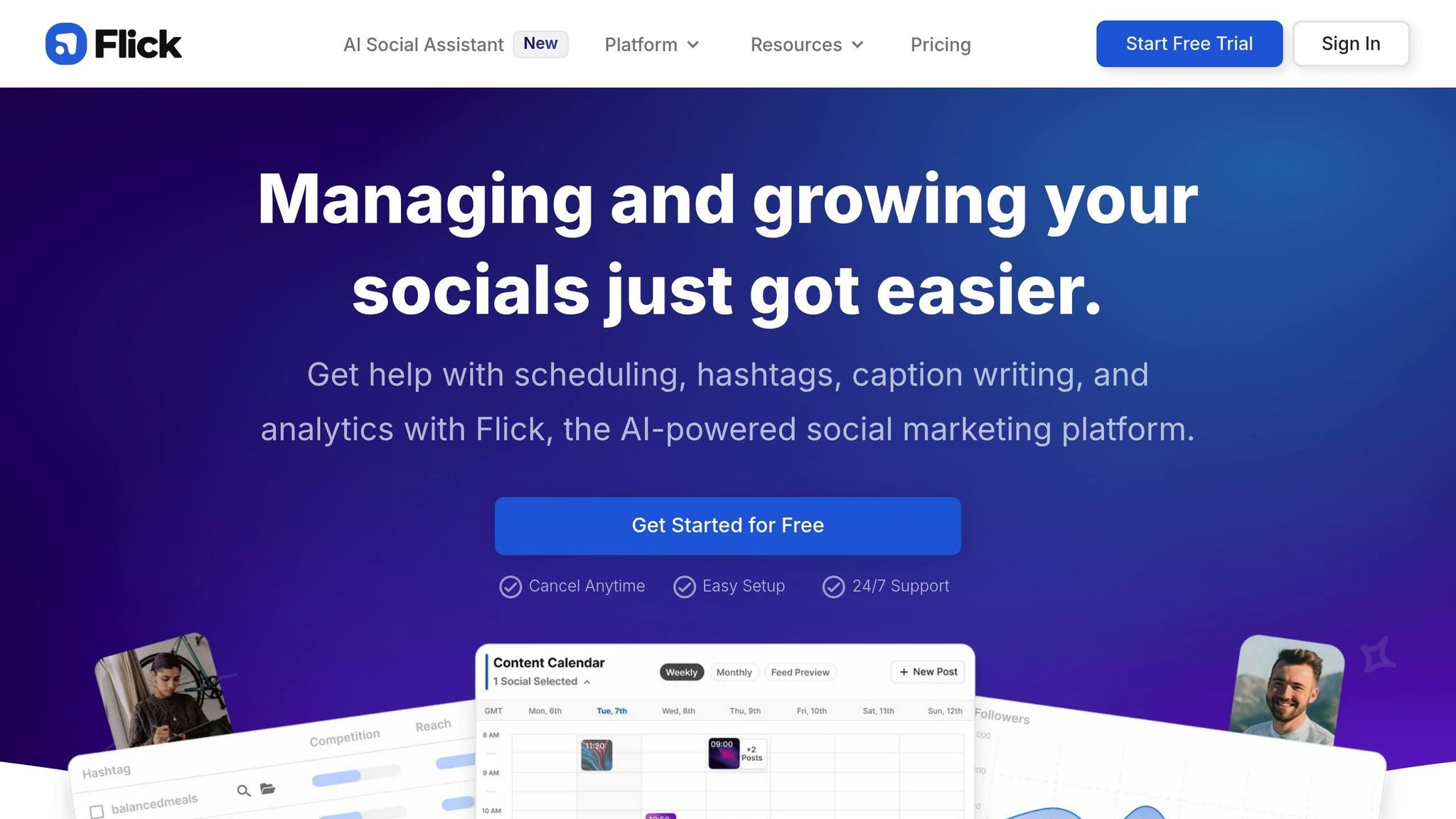
BuzzSumo might be your go-to for content research and competitive analysis, but Flick steps in as a social media AI copilot, designed to help marketers manage content calendars with precision. It doesn’t just schedule posts; it helps teams make smarter decisions about what to post, when to post it, and how to drive engagement.
Predictive Analytics
Flick takes the guesswork out of scheduling by pinpointing the best times to post. It analyzes audience activity and engagement patterns, then suggests optimal posting schedules. For instance, if your audience is most active on Tuesday mornings, Flick will highlight that, allowing you to schedule posts when they’re most likely to see them.
The platform doesn’t stop at scheduling – it tracks campaign performance, capturing key metrics like reach and engagement. This data reveals trends, such as whether video content outperforms static images or if certain times of day yield better results. Armed with these insights, teams can fine-tune their strategies, planning weekly or monthly content with confidence based on what’s worked before.
Content Personalization
Flick goes beyond timing by helping you tailor content that truly connects with your audience. Its AI-powered caption generator adapts to your audience’s tone and voice, ensuring your messaging feels authentic and relatable. This is especially important in today’s marketing landscape, where maintaining brand consistency across platforms while personalizing for different audiences is crucial.
To keep things organized, Flick offers campaign folders that let marketers segment content by audience type, campaign goals, or platforms. For example, you can create folders for seasonal promotions, product launches, or specific themes, each containing captions, hashtags, and templates tailored to the campaign. This structure makes it easy to build personalized content calendars for different customer segments.
By training its AI to replicate your brand’s voice, Flick allows you to scale content production without compromising quality or authenticity. Captions align with your brand guidelines and audience preferences, ensuring consistent messaging across all platforms.
SEO Optimization
Flick also helps your content reach the right audience through smart social media SEO. Its hashtag recommendation tool analyzes live data to suggest trending, high-performing hashtags that can boost your reach. This real-time insight is a game-changer for improving visibility.
Additionally, Flick’s recommendations for the best posting times ensure your content is published when algorithms are most likely to prioritize it in user feeds. By combining strategic hashtag use with optimized timing, Flick maximizes your chances of getting your posts in front of the right people at the right time.
Integration Capabilities
Flick isn’t just a scheduling tool – it’s a full-fledged content management solution that integrates seamlessly into modern marketing workflows. Its features, like the content calendar, campaign folders, and performance tracking, work together to create a centralized hub for planning and optimization.
Marketers can use the campaign folders to keep their content calendar organized, making it easier to manage complex initiatives. Regular performance reviews – whether weekly or monthly – help teams identify what’s working and apply those insights to future campaigns.
This iterative process ensures continuous improvement. With live data integration and real-time tracking, Flick allows marketers to quickly adapt to trends, balancing long-term strategy with the flexibility needed to respond to shifting audience interests.
Advantages and Disadvantages
As AI continues to reshape content planning, it’s important to weigh the strengths and weaknesses of available tools. Each platform offers specific benefits and limitations, making it essential to choose the right fit for your team’s workflow and goals.
Copy.ai is a go-to for creating blog posts, social media content, and email copy quickly, while allowing for customizable styles that align with a brand’s voice. However, it focuses solely on content creation – it doesn’t assist with research, scheduling, or tracking performance.
BuzzSumo shines in content research and competitive analysis, helping identify trending topics and uncover what resonates most in your industry. It also provides keyword suggestions to improve SEO. That said, it doesn’t support content creation or scheduling.
Flick caters specifically to social media, with a focus on Instagram. It uses AI to craft captions that reflect your audience’s tone and suggests hashtags based on live data to boost visibility. Features like campaign folders help organize content by theme or audience, while performance tracking delivers real-time insights. However, its narrow scope means it doesn’t support blog writing, email campaigns, or broader marketing initiatives.
Research underscores the value of aligning content strategies with data-driven approaches. Companies that do so are 60% more likely to achieve their marketing goals. For example, a HubSpot case study reported a 50% increase in lead generation, while a 2023 survey found that 72% of marketers saw better content performance.
Still, AI tools have their drawbacks. AI-generated content often lacks the nuanced creativity and authentic voice that human writers bring, requiring teams to refine the output. Over-relying on AI can lead to repetitive, generic content, which diminishes competitive differentiation. These tools are designed to support strategic thinking – not replace it – and require careful integration and monitoring.
Another challenge lies in the learning curve and upfront investment. Teams need to spend time training on these platforms and developing workflows to maximize efficiency. For instance, Copy.ai users may need copywriting expertise to polish outputs, while BuzzSumo and Flick demand skills in data analysis and social media strategy, respectively. Establishing governance frameworks ensures AI-generated content maintains quality and brand consistency.
Data privacy is another critical factor when selecting AI tools. Teams must understand how these platforms handle data – whether it’s retained, used for model training, or risks exposing proprietary information. Some enterprise versions offer privacy guarantees, while standard versions may use submitted content to improve AI models.
Here’s a breakdown of the tools discussed:
| Tool | Primary Strengths | Key Limitations | Best For |
|---|---|---|---|
| Morpheus | Real-time insights, predictive analytics, custom dashboards, multi-platform support | Limited AI content generation, no unified inbox, no social listening | Teams focused on data analysis and performance prediction |
| Copy.ai | Quick content creation, customizable styles, brand voice consistency | Lacks scheduling, research, and analytics features | High-volume content teams needing consistent branding |
| BuzzSumo | Trend identification, competitive analysis, SEO keyword suggestions | No content creation or scheduling capabilities | Research-driven teams in the planning phase |
| Flick | AI captions, smart hashtags, campaign organization, performance tracking | Limited to Instagram and social media focus | Social media teams prioritizing engagement and visibility |
Pricing for these tools varies. For instance, Notion offers a free plan with paid options starting at $10/month, with a 20% discount for annual billing. Many AI content calendar tools follow tiered pricing models, combining free and premium plans.
For smaller teams on a budget, Copy.ai is a cost-effective choice for generating content at scale, ensuring consistent publishing schedules. BuzzSumo is ideal for teams seeking deep research insights before creating content, while Flick suits social media teams looking to enhance engagement through specialized tools.
Adopting these platforms comes with challenges, particularly the need for teams to adapt their workflows. AI integration often requires reorganizing content calendars by theme, funnel stage, persona, and purpose – demanding a more detailed approach than traditional deadline-based scheduling. Resistance to change among team members accustomed to older methods can also slow adoption.
A smart approach is to use AI as a starting point. Generate first drafts, then have brand specialists review and refine the content to ensure it aligns with your voice and quality standards.
Conclusion
AI has completely reshaped the way content calendars are managed. What used to be simple scheduling tools have now evolved into dynamic systems capable of adapting strategies in real time. This evolution allows marketers to concentrate on big-picture planning and creativity, while AI takes care of repetitive tasks like scheduling, content creation, and performance tracking.
These tools streamline every phase of the content process. For example, Copy.ai speeds up content creation while ensuring your brand’s voice stays consistent. BuzzSumo provides the competitive insights and trend analysis needed for smarter planning. Meanwhile, Flick enhances social media performance by generating AI-powered captions and recommending effective hashtags.
The results speak for themselves. Businesses that align their strategies with data-backed tools are 60% more likely to hit their marketing goals. HubSpot’s case study reported a 50% boost in lead generation, and Team-GPT cut content creation time by 40% using AI-driven workflows.
If you’re considering adopting these technologies, start by pinpointing your main challenges. For example, if you need faster content creation, Copy.ai could be your go-to. If understanding trends and competitors is your priority, BuzzSumo is a smart pick. Social media teams, on the other hand, might find Flick invaluable for platform-specific tasks. The key is to align your tool choices with your business goals, whether that’s increasing leads, building brand awareness, or driving engagement.
The "One Idea, Many Formats" approach has become a standard practice by 2025. Teams can now effortlessly turn a single topic into blogs, videos, social posts, and infographics. This method not only extends the reach of each idea but also helps optimize resources, ensuring consistent publishing across multiple platforms.
However, effective implementation requires careful planning. Set clear, measurable goals before diving into new tools. Build flexibility into your processes so you can adapt quickly to shifting trends or unexpected challenges. Use AI to kickstart content creation, but rely on human editors to refine the output, maintain brand authenticity, and meet editorial standards.
Looking ahead, content calendars are expected to become more predictive rather than reactive. AI will help marketers anticipate audience preferences and market trends before they fully emerge. This means teams will be able to craft proactive strategies instead of just responding to changes. Advanced AI capabilities like sentiment tracking and cross-channel optimization will take on more complex tasks, giving marketers more time to focus on storytelling and creative strategy.
For businesses seeking an all-in-one solution, partnering with agencies like Dreamtown Creative could be a game-changer. They combine AI-powered tools with strategic expertise in branding and content, offering services like fractional brand strategy, content creation, and marketing campaigns – all designed to drive measurable growth. By leveraging modern tools and expert insights, agencies like these can help businesses stay ahead in an ever-evolving digital landscape.
FAQs
How can AI tools improve the efficiency and impact of content calendars in marketing strategies?
AI tools are changing how marketers approach content calendars by taking over tedious tasks and offering insights backed by data. They can assess audience behavior, forecast trends, and pinpoint the best times to post, making it easier for marketers to keep up in today’s fast-moving digital world.
For example, AI-driven platforms can suggest content ideas based on trending keywords, simplify scheduling, and even tailor content to fit different audience segments. Incorporating AI into your content calendar planning can help you work more efficiently, boost engagement, and maintain steady performance across your campaigns.
What challenges can arise from using AI-generated content, and how can marketing teams address them?
AI-generated content is great for saving time and scaling up production, but it often misses the mark when it comes to originality, emotional depth, or capturing a brand’s unique personality. Relying too heavily on AI can lead to content that feels bland or disconnected from the audience it’s meant to engage.
The solution? Blend the strengths of AI with human creativity. Regularly review and tweak AI-generated material to make sure it aligns with your brand’s voice and values. By adding human oversight, you keep the content authentic and relatable. Meanwhile, using AI strategically can speed up routine tasks, giving your team more time to focus on creative, high-impact projects.
How do AI tools like Copy.ai and Flick simplify and enhance marketing workflows?
AI tools like Copy.ai and Flick simplify marketing tasks by automating processes such as content creation, scheduling, and performance tracking. They work effortlessly with other platforms, enabling marketers to handle campaigns more efficiently while keeping a consistent brand voice across all channels.
With the help of AI-powered insights, businesses can fine-tune their content strategies, spot emerging trends, and make decisions based on solid data. This approach not only cuts down on time spent but also boosts the impact of marketing efforts, giving brands an edge in today’s competitive market.
Related Blog Posts
- AI and the New Brand Playbook: Strategic Design That Drives Measurable Growth
- Scaling Brand Authority in the AI Era: High-Impact Solutions for Lean Teams
- Strategic Creativity for the AI Age: Brand Identities That Command Attention
- The Competitive Edge: Branding Strategies That Thrive in AI-Shaped Markets