
Silicon Hills Storytelling: Crafting a Brand Strategy for Disruptive Tech

In Silicon Hills, home to over 5,500 tech companies, storytelling is the key to making complex innovations understandable and relatable. It’s not enough to have great technology – brands need narratives that connect with customers and investors. Data shows that story-driven content grows user bases four times faster than feature-focused advertising.
Here’s why this matters:
- Trust is scarce: With major tech players losing billions, people are skeptical of overhyped claims.
- Complex tech needs clarity: Innovations like AI and quantum computing require simple, relatable explanations.
- Silicon Hills thrives on collaboration: The region values community-oriented, relatable brands.
This article explores how to define your value, simplify your message, and use storytelling frameworks to connect with Silicon Hills’ unique audience. From ICON’s 3D-printed homes to YETI’s niche storytelling, the examples here prove that clear, relatable stories can drive growth – even for the most complex technologies.
Understanding the Silicon Hills Ecosystem
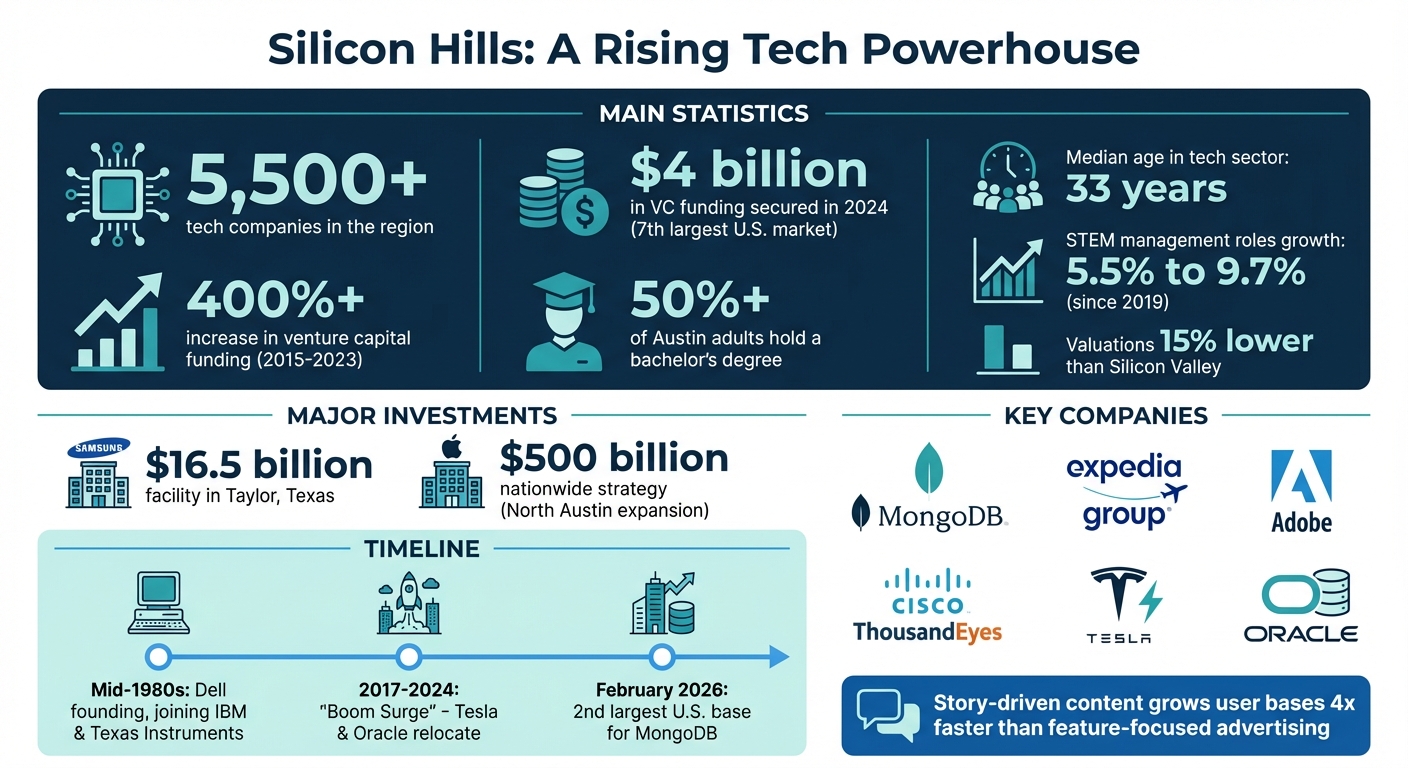
Silicon Hills Tech Hub Growth: Key Statistics and Milestones 2015-2026
The Growth of Silicon Hills as a Tech Hub
The rise of Silicon Hills began in the mid-1980s with Dell’s founding, joining established players like IBM, Texas Instruments, and the University of Texas at Austin. Fast forward to the period between 2017 and 2024, often referred to as the "Boom Surge", when companies like Tesla and Oracle moved their headquarters or set up significant operations in the area, drawing in a wave of new residents and businesses. By February 2026, Silicon Hills had grown into a formidable rival to Silicon Valley, hosting the second-largest U.S. base for MongoDB and key offices for companies like Expedia Group, Adobe, and Cisco ThousandEyes.
From 2015 to 2023, venture capital funding in Austin skyrocketed by over 400%. Major investments, such as Samsung‘s $16.5 billion facility in Taylor, Texas, and Apple’s North Austin expansion as part of a $500 billion nationwide strategy, cemented the region’s long-term appeal. These moves weren’t just about relocating corporate offices – they were strategic decisions that brought along suppliers, talent, and entire supply chains.
Collaboration has been the cornerstone of Silicon Hills’ growth. Thom Singer, CEO of the Austin Technology Council, describes it as:
"Austin’s tech story is a white paper for how to build a community".
Resources like Capital Factory and the Austin Technology Incubator provide mentorship and support to help startups scale. The region fosters an inclusive environment, where newcomers are welcomed into the ecosystem, unlike the more exclusive networks of other tech hubs. Over time, the area has shifted from a focus on hypergrowth to what BPM calls "sustainable momentum" – a strategy aimed at developing and retaining experienced professionals rather than solely attracting new talent. This shift is evident in the numbers: STEM management roles have nearly doubled, growing from 5.5% to 9.7% of the tech workforce since 2019. As the ecosystem has matured, it has cultivated distinct expectations that now shape how brands connect with this audience.
Audience Characteristics in Silicon Hills
The growth and evolution of Silicon Hills have given rise to a unique audience with specific priorities and values that brands must understand to succeed.
Local tech leaders place a high value on civic engagement, reflecting the region’s distinctive culture. Thom Singer highlights this by saying:
"Authenticity isn’t just a buzzword in Austin; it’s the only way both an individual and a community can thrive".
This mindset stems from the legacy of the "Keep Austin Weird" movement, which underscores the importance of genuine community involvement and social responsibility. Many tech leaders in the area tackle issues like infrastructure and affordability, blending innovation with civic-mindedness.
The workforce in Silicon Hills is both highly educated and lifestyle-oriented. With over 50% of adults in Austin holding a bachelor’s degree and the median age in the tech sector at 33, the region boasts a youthful and skilled population. However, unlike the fast-paced coastal hubs, professionals here prioritize work-life balance. Economist Bernard Weinstein from Southern Methodist University notes:
"The city has done a great job marketing itself as a less hectic, more laid-back version of Silicon Valley".
Austin’s favorable climate and vibrant cultural offerings further reinforce this balance, and the local audience expects brands to align with their emphasis on both professional success and quality of life.
Investors in the region approach opportunities with practical expectations. Valuation multiples are about 15% lower than those in Silicon Valley, creating what many describe as a "resilient" investment climate that weathers economic ups and downs. In 2024, Austin secured nearly $4 billion in venture capital funding, making it the seventh-largest U.S. market for startup investment. However, the focus has shifted away from general SaaS solutions toward specialized expertise in fields like healthcare, construction technology, and advanced manufacturing. To resonate with this audience, brand narratives need to demonstrate deep industry knowledge rather than broad, surface-level capabilities.
These insights into Silicon Hills’ audience provide a roadmap for crafting stories that connect with the region’s vibrant, forward-thinking tech community.
Creating a Brand Narrative for Disruptive Tech
Defining Your Value Proposition
Every great tech brand story starts with a clear understanding of what sets your solution apart. In a competitive hub like Silicon Hills – home to over 5,500 startups and tech companies vying for attention – you need to articulate how your innovation solves specific pain points. This isn’t about listing features; it’s about showing how your product becomes an essential part of your customers’ lives.
The key is connecting directly to customer pain points and presenting your brand as the answer. For example, instead of diving into the technical details of your AI platform, emphasize its impact: turning a month of data analysis into something manageable over a single lunch break. This humanizes your brand, making it more than just a product – it becomes a relatable solution that prioritizes real-world needs.
Using brand archetypes can also help define your voice and personality. Think of The Outlaw, which challenges norms like Harley-Davidson, or The Magician, which delivers transformative experiences like Apple. Many tech brands successfully blend archetypes. For instance, Stripe combines The Hero’s leadership with The Magician’s ability to simplify complex payment systems into something effortless. Choose archetypes that reflect your innovation and resonate with the Silicon Hills audience. Then, use storytelling frameworks to craft a compelling narrative around your value.
Storytelling Frameworks for Tech Brands
A strong tech narrative follows proven structures that guide audiences from identifying a problem to embracing a solution. One effective option is the Problem-Solution-Impact framework. This approach highlights the pain caused by the current status quo, introduces your technology as the solution, and paints a clear picture of the better future your innovation enables.
Another option is adapting the Hero’s Journey to your brand’s story. Start with the "Ordinary World" (the pre-innovation state), move to the "Call to Adventure" (recognizing the problem), navigate through the "Tests and Allies" (development challenges), and conclude with the "Return with the Elixir" (your innovation changing the landscape).
For a customer-focused approach, consider the Mentor Brand Blueprint, which positions your brand as the guide helping customers – the real heroes – overcome their challenges. This framework aligns well with the collaborative spirit of Silicon Hills and builds trust when your messaging is consistent across platforms.
Making Innovation Relatable
Complex technologies can be intimidating, but grounding them in familiar concepts makes them easier to grasp. Analogies are a powerful tool for bridging the gap. For instance, instead of explaining encryption with technical jargon, describe it as a "digital handshake" that confirms identity. Or, frame quantum computing as "a million parallel universes working together to solve a problem" rather than diving into qubit mechanics.
Since the brain processes visuals 60,000 times faster than text, it’s smart to tell your story using multiple media formats. Create high-impact, “movie trailer” style visuals for social media and pitch decks, while offering detailed white papers for industry professionals. Tailor your message to your audience’s priorities: investors want to hear about market potential and ROI, while customers care about how your solution addresses their specific needs.
Above all, focus on the transformation your technology brings, not just the technical specs. As Unhyped puts it:
"Your groundbreaking technology means nothing if you can’t explain it".
Tools and Techniques for Effective Storytelling
Using Visual Storytelling
When it comes to simplifying complex tech, visuals are your secret weapon. The human brain processes images in just 13 milliseconds, making them a powerful tool for communicating intricate ideas. For instance, instead of listing features of your AI platform, create a visual journey. Start with chaotic, cluttered imagery to represent disorganized workflows, then transition to clean, structured visuals that highlight your solution.
Color selection plays a bigger role than you might think. Blue and gray tones convey trust and dependability, making them ideal for enterprise software. On the other hand, red can create a sense of urgency, which is great for solutions that need immediate attention. Here’s a quick tip: apply the "Squint Test" to your graphics. If someone can’t grasp the main idea when viewing it slightly blurred, it’s likely too complicated.
Short-form videos are expected to deliver the best ROI by 2026, but the challenge is capturing attention fast – within the first eight seconds. These visual techniques are key to making your content stand out and work effectively across digital platforms.
Digital Platforms for Sharing Brand Stories
With 5.56 billion social media users spending over two hours daily on these platforms, it’s essential to meet your audience where they are. By 2026, platforms like Instagram will function more like search engines, making natural keywords in captions, alt-text, and video overlays critical for discovery.
Consider a 3-Act Publishing Structure to keep your audience hooked. Start by introducing a problem on Monday, follow up with the obstacle on Wednesday, and wrap up with the solution on Friday. This serialized storytelling approach keeps people engaged and eager to see the conclusion. Instagram carousels consistently generate higher engagement, while videos under 60 seconds perform best across all platforms.
For an extra edge, try "Story Retargeting". This involves targeting users who watched at least 50% of your "problem" video with follow-up content that showcases your solution, like a case study or product demo. This strategy builds on their interest, turning casual viewers into potential customers.
Data-Driven Storytelling for Tech Companies
Data can turn a good story into a compelling one. By adding context to raw statistics, you can craft narratives that resonate with real customer experiences. Companies that use data-driven storytelling see 55% higher conversion rates. A standout example is Spotify’s "Wrapped" campaign in December 2020. By turning individual listening data into personalized stories, they boosted app downloads by 21% in just one month.
The trick is progressive disclosure. Start with eye-catching headlines to draw people in, then let them explore deeper insights if they’re interested. IBM nailed this approach by creating data stories around client successes, complete with quantified results. This strategy cut their enterprise sales cycle by 31% and increased adoption rates by 43%. Instead of just presenting charts, they explained what the numbers meant for decision-makers facing similar challenges.
Before crafting your story, use the "Information Shovel" method to dig into market data and customer feedback. This ensures your narrative is grounded in reality, not assumptions. Being transparent about setbacks and explaining the reasons behind them – rather than presenting a flawless image – builds trust over time. As Mike Novogratz, Founder and CEO of Galaxy Digital, wisely says:
"The gap between the really great and the next level is discipline. You have to have a set of rules that you follow."
Examples of Successful Storytelling in Silicon Hills
Case Study: A Local Disruptive Tech Success
ICON is a perfect example of how storytelling can turn complex technology into a movement with real-world impact. Since its launch in 2017, CEO Jason Ballard has framed the company’s 3D-printed construction technology as a way to address the global housing crisis. Instead of diving into technical jargon, Ballard focused on the human side of the issue, stating:
"1.6 billion of our sisters and brothers do not have housing and shelter that you would find adequate… I’m here to argue that it’s time to build." – Jason Ballard, CEO, ICON
ICON’s story isn’t just talk – it’s backed by action. In March 2018, the company built the first permitted 3D-printed house in the U.S. during SXSW in East Austin, grabbing national attention. Fast forward to November 2022, and that compelling narrative helped ICON secure a $57.2 million NASA contract to develop lunar construction systems. The company has raised approximately $451 million in funding, printed 150 homes, and is nearing completion of Wolf Ranch, a 100-home 3D-printed community in Georgetown, TX. Ballard adds another layer to ICON’s story by connecting its architectural designs to societal ideals, explaining:
"Curves are almost always associated with utopia. Things get rounder as society gets more just and advanced in our imagination."
ICON also highlights sustainability concerns, pointing out that traditional stick-frame construction generates about 8,000 pounds of waste for a 2,000-square-foot home.
ICON’s achievements show how a well-told story can simplify complex innovations and inspire action, paving the way for other leaders in the industry.
Lessons from Industry Leaders
ICON isn’t the only company leveraging storytelling to simplify and amplify complex ideas. Other industry leaders offer valuable lessons on how to use narratives effectively.
Take Strangeworks, for example. Founded by William "Whurley" Hurley, the company focuses on making quantum computing more approachable. Hurley uses simple analogies, like comparing quantum computing’s "probabilistic states" to a golf ball, to help people grasp the concept. This approach has allowed Strangeworks to create a virtual network that connects developers to over 90 quantum machines worldwide, including 40 from IBM. As Hurley put it:
"I saw quantum computing as future science fiction that was going to happen right now."
The quantum computing industry, valued at $800 million in 2023, is projected to grow to over $5 billion by 2030.
YETI offers another storytelling lesson: focus on depth before chasing mass appeal. Instead of rushing to capture a broad audience, the Austin-based company allowed niche communities like surfers, hunters, and lobster fishers to discover its products naturally. Since 2015, YETI has leaned heavily into storytelling, producing over 75 films, including "The Captain", which shares the journey of a female lobster fisher. This strategy has clearly paid off – YETI now boasts a $3.38 billion market cap and reported $652.9 million in Direct-to-Consumer sales during the first nine months of 2023, a 7% increase from the previous year.
These stories from ICON, Strangeworks, and YETI show that storytelling isn’t just marketing content – it’s a way to build connections, simplify the complex, and drive growth.
Conclusion: Building a Story That Resonates
In the thriving Silicon Hills ecosystem, home to more than 5,500 tech companies, your brand’s story isn’t just another marketing tool – it’s the key to bridging complex innovations with customer understanding. As the region shifts from rapid expansion to a more focused, strategic phase, success hinges on blending advanced technology with narratives that connect on a human level. In fact, story-driven content outperforms feature-focused ads by a factor of four, proving that in 2026’s "narrative economy", the real value lies in the power of storytelling, not just the code behind the product.
Moving forward takes discipline and consistency. Mike Novogratz captures this perfectly: "The gap between the really great and the next level is discipline. You have to have a set of rules that you follow". Building trust requires radical transparency – acknowledging setbacks, explaining your approach, and delivering on your promises. This disciplined authenticity ensures your internal practices align with the story you share externally.
Your brand’s credibility grows when your operations mirror your message. By using relatable analogies, you can simplify complex technologies and make them accessible, all while positioning your customers as the heroes of their own journey. A story that makes the abstract feel tangible and the future seem within reach is what truly resonates.
Silicon Hills offers a unique edge by merging Austin’s creative spirit with its robust entrepreneurial infrastructure. To stand out in this competitive landscape, your narrative must reflect both innovation and authenticity. A compelling story will always outshine a list of technical specs in capturing hearts and minds.
FAQs
What’s the fastest way to turn complex tech into a simple story?
The quickest path is to use storytelling techniques that break down complex ideas and make them relatable. Instead of diving into technical specifics, focus on a narrative that emphasizes the benefits and the real-world impact of the technology. Using structured approaches or frameworks can also help turn abstract concepts into clear, engaging stories. This approach helps non-technical audiences connect with the message and see how the innovation fits into their lives.
How do I tailor one brand story for customers and investors?
To craft a brand story that resonates with both customers and investors, start by focusing on the values they both care about. For customers, showcase how your product or service solves real-world problems and improves their lives in a practical, relatable way. For investors, shift the focus to growth opportunities, market influence, and the forward-thinking aspects of your business. By using a unified storytelling approach, you can ensure your message is clear, relatable for customers, and instills confidence in investors, creating a balance that speaks to both groups effectively.
Which metrics show my storytelling is working?
Metrics that show your storytelling is hitting the mark include audience engagement – like a boost in website traffic or more interactions on social media – and shifts in brand perception. Tools like customer surveys, sentiment analysis, and tracking loyalty trends can help measure these changes. When you see positive feedback and higher engagement, it’s a clear sign your story is connecting with people.
Related Blog Posts
- Beyond Templates: Tailored Branding Strategies for Competitive Tech and Startup Markets
- From Vision to Visibility: Building Scalable Brands in a Disrupted Search Landscape
- Elevating Digital Presence with Data-Driven Design and Storytelling
- Your Brand, Amplified: Creative Solutions for Results-Focused Leaders