7 Questions to Ask Before Partnering with a B2B Tech Marketing Agency

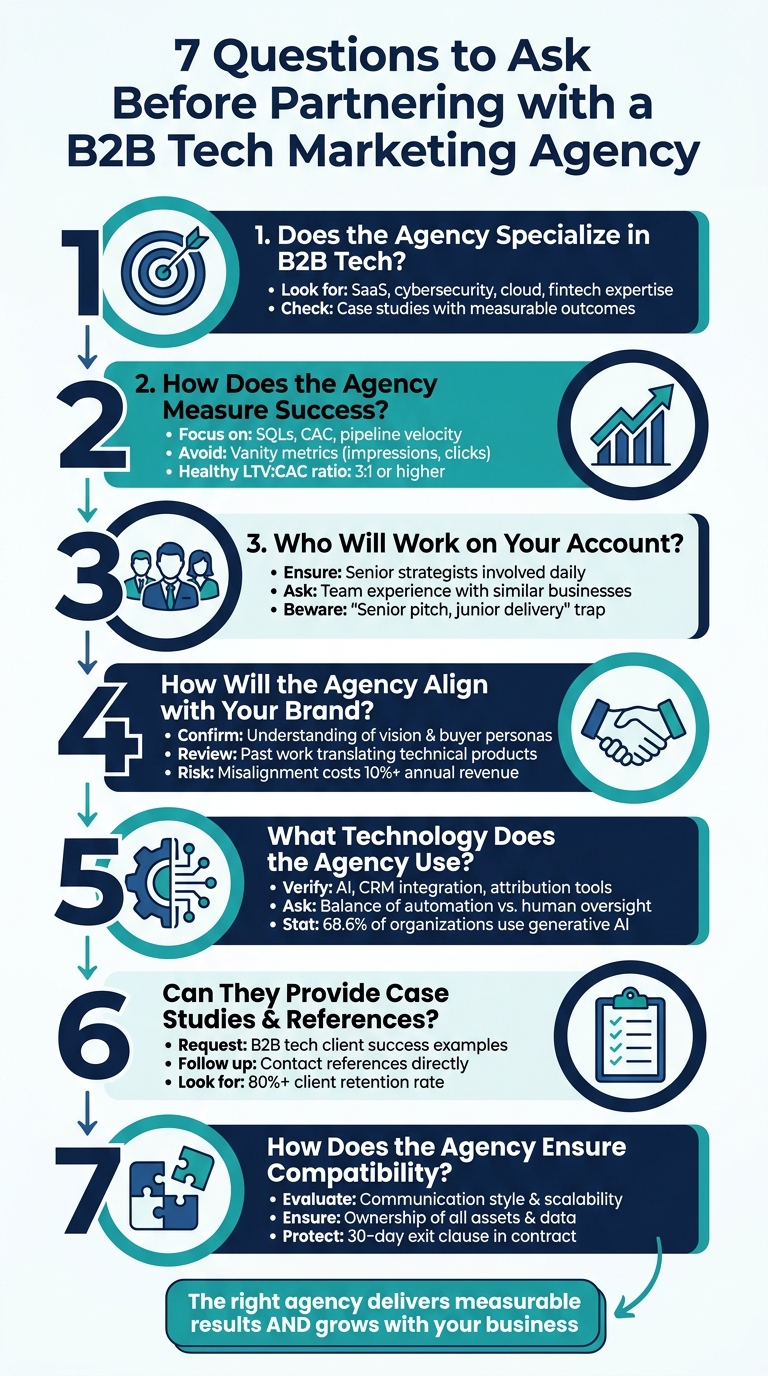
Choosing the right B2B tech marketing agency can make or break your business growth. With the complexity of B2B sales cycles and the high stakes of marketing budgets, you need a partner who understands your industry inside out. Here are the seven key questions to ask when evaluating potential agencies:
- Does the agency specialize in B2B tech?
Look for expertise in SaaS, cybersecurity, cloud infrastructure, or fintech. Check their case studies for measurable outcomes like pipeline growth and revenue impact. - How does the agency measure success?
Focus on revenue-linked metrics like SQLs, CAC, and pipeline velocity. Avoid agencies that rely on vanity metrics like impressions or clicks. - Who will work on your account?
Ensure senior strategists, not just junior staff, are involved in day-to-day execution. Ask for clarity on team roles and their experience with similar businesses. - How will the agency align with your brand?
Confirm they’ll take the time to understand your vision and buyer personas. Review their past work for translating technical products into clear, relatable messaging. - What technology does the agency use?
Verify their tech stack includes advanced AI, CRM integration, and robust attribution tools. Ask how they balance automation with human oversight. - Can they provide case studies and references?
Request specific examples of their success with B2B tech clients. Follow up with references to gauge client satisfaction and long-term results. - How does the agency ensure compatibility?
Evaluate their communication style, scalability, and ability to grow with your business. Ensure you’ll retain ownership of all assets and data.
Quick Overview
- Focus on agencies with proven B2B tech expertise.
- Prioritize revenue-driven metrics over vanity stats.
- Confirm team experience and tech capabilities.
- Request case studies and client references.
- Align on communication and long-term compatibility.
By asking these questions, you can identify an agency that delivers measurable results and aligns with your business goals.
7 Essential Questions to Ask Before Choosing a B2B Tech Marketing Agency
Question 1: Does the Agency Focus on B2B Tech?
A specialized B2B tech agency brings more than just marketing skills – they bring deep industry understanding. They already know the nuances of subscription-based business models, the complexities of decision-making committees, and how to communicate effectively with technical leaders. For example, when an agency understands how a CISO evaluates risk versus how a CTO prioritizes scalability, you save time and avoid the frustration of explaining these dynamics from scratch.
"If they say ‘we work across all B2B’ – that’s not expertise, that’s generalism dressed up as flexibility." – Jamie Partridge, Founder & CEO, UpliftGTM
The best agencies demonstrate in-depth knowledge in sectors like SaaS, cybersecurity, cloud infrastructure, or fintech. They’re familiar with your competitors, industry events, and the objections buyers face during long sales cycles. This kind of expertise means campaigns get off the ground faster, and the messaging resonates right from the start. Look for proof of this knowledge in their case studies and the precision of their messaging.
Review Case Studies and Results
The clearest way to evaluate an agency’s expertise is through their results. Ask for case studies that show measurable outcomes, not just surface-level metrics like impressions or clicks. For instance:
- In April 2026, Tiller Digital worked with Solutionreach to refine paid campaign targeting using a test-and-learn strategy. By shifting the focus from high MQL volume to pipeline impact, they achieved a 10x year-over-year increase in inbound enterprise pipeline and generated over $2 million in a single month.
- Tiller Digital also partnered with SeisWare to simplify complex geoscience software messaging. The results? A 93% boost in conversions, a 23% uptick in organic traffic, and a tripling of U.S.-based Requests for Information (RFIs).
These examples highlight why it’s critical to choose an agency that understands the specific challenges of B2B tech.
Check Their Knowledge of Tech Buyer Personas
An effective agency knows how to craft messaging for varied stakeholders within a buying committee, which often includes 8–13 decision-makers. These stakeholders range from technical champions like CTOs to business-focused sponsors like COOs. During your evaluation, ask the agency to explain your product to a non-technical buyer. Can they make your complex product relatable and compelling?
For example, WaitWell faced the challenge of addressing diverse buying committees across government, healthcare, and education. Tiller Digital created persona-specific, conversion-driven copy that spoke directly to each audience’s concerns. This approach led to a 91% increase in "Talk to Sales" pageviews and a 74% reduction in bounce rate on their interactive demo.
Choosing an agency with a proven track record in B2B tech ensures they can hit the ground running, delivering results that matter to your business.
Question 2: How Does the Agency Track Success?
When evaluating an agency, it’s crucial that they can demonstrate how they measure and prove the success of their campaigns. This is especially important in B2B tech, where sales cycles can stretch for months and often involve multiple decision-makers – typically six to ten people. To ensure you’re getting real value, ask upfront: What metrics do they prioritize, and how will they show the impact of their efforts on your business?
Metrics That Matter
The most effective agencies focus on metrics that connect directly to revenue. These include Marketing Qualified Leads (MQLs), Sales Qualified Leads (SQLs), Customer Acquisition Cost (CAC), and pipeline contribution. While vanity metrics like impressions may sound impressive, they don’t necessarily drive revenue or prove a campaign’s success. Instead, these measurable, revenue-linked KPIs provide a clear picture of whether your marketing efforts are paying off.
As Liam Bartholomew, Global Head of Demand Generation at Cognism, explains:
"An SQO is a sales rep, saying, ‘I think this could close,’ and you want to be generating as many of those as possible. It’s important to note that all SQOs are not the same. Although indicative of a successful campaign, your incoming revenue is the most honest indicator of campaign success."
Key Metrics for B2B Tech Campaigns
A reliable agency will monitor metrics across the entire funnel. These might include Pipeline Velocity, CAC Payback, Account Engagement, Monthly Recurring Revenue (MRR), and Customer Lifetime Value (CLV). For example, ASP Marketing helped Kladana achieve a sixfold increase in organic visits and boost AI-engine citations from 0% to 30% over an 18-month period, ending in 2026.
Another important metric to watch is the LTV:CAC ratio, which is a measure of how much revenue each customer generates compared to the cost of acquiring them. For B2B tech companies, a healthy ratio is generally 3:1 or higher. Be sure to ask how the agency plans to help you reach or maintain this benchmark. Additionally, confirm they can explain their attribution model – whether it’s W-shaped, time-decay, or another approach – and how it ties marketing spend to closed-won revenue.
Reporting and Transparency
Clear, transparent reporting is a hallmark of a strong agency. Before signing a contract, ask how often they’ll provide updates – whether weekly, monthly, or quarterly – and in what format. Top agencies often offer real-time dashboards through tools like HubSpot, Salesforce, Tableau, or Power BI, giving you instant access to performance data.
It’s also critical to align on key definitions from the start. For example, what qualifies as a "lead"? Which industries, job titles, or company sizes should they target? Without this clarity, some agencies might inflate their numbers by delivering leads that look good on paper but fail to convert. Additionally, ensure that you retain ownership of all ad accounts, pixel data, and creative assets from day one. This not only prevents lock-in but also keeps you in full control of your marketing data.
Testing the Partnership
A great way to test an agency’s effectiveness is by starting with a 90-day pilot program rather than committing to a full year. This trial period allows you to see if they can move key indicators like MQLs and engagement scores before making a long-term investment. During this time, pay attention to how they handle underperforming campaigns. Are they proactive in sharing insights and suggesting adjustments, or do you have to chase them for updates? Their responsiveness during the pilot phase will reveal whether they’re a true partner or just another vendor.
Question 3: Who Will Work on My Account?
Once you’ve reviewed performance metrics, it’s time to focus on the team managing your strategy. A common issue in agency partnerships is the "senior pitch, junior delivery" trap. This happens when you’re sold on the expertise of a founder or senior strategist during the sales process, but the day-to-day work ends up in the hands of someone lacking experience in B2B tech. To avoid this, ask directly: Who will be working on my account daily, and what is their specific background in B2B tech marketing?
Team Roles and Experience
A capable B2B tech agency should include brand strategists, creative designers, and tech marketers, with senior leadership providing strategic oversight. Before committing, request a 30-minute meeting with your assigned team. This gives you the chance to confirm their expertise and ensure they grasp the unique challenges of B2B tech, such as extended sales cycles, multiple decision-makers, and technical buyer priorities like ROI and security.
Additionally, find out if the agency outsources or white-labels services like SEO or content creation. This could mean you’re paying premium rates for work handled by freelancers. It’s also worth asking about the Average Contract Value (ACV) of their current clients. If your deals average $100,000+ but their experience is with $5,000 contracts, they may not be equipped to handle the complexity or speed of your sales process.
| Monthly Retainer | Typical Team Support |
|---|---|
| $3,000–$7,000 | Junior account manager and one specialist; limited strategy involvement |
| $8,000–$20,000 | Dedicated account manager, regular strategy calls, and monthly access to a senior strategist |
| $20,000+ | Senior strategists assigned directly, custom analytics, and executive-level reporting |
Source:
This structured approach to team roles ensures clear accountability and effective collaboration.
Point of Contact and Workflow
Your primary contact will typically be an account manager who acts as the bridge between the agency and your team. For the best results, assign someone from your internal team to actively manage the partnership. Heather Salerno, CMO at AppCast, offers this advice:
"Find a good agency with people that you enjoy working with. You’re going to spend a lot of time with them."
Ask how the agency handles communication. Do they use tools like Slack or project management platforms? How often will you meet for strategy discussions – weekly, monthly, or quarterly? Setting a clear communication rhythm from the beginning helps avoid a passive, ineffective relationship. After the first 90 days, check whether your contact is focusing on revenue-driven metrics rather than vanity stats. This will help you determine if they’re a true partner invested in your success or just another vendor.
Knowing who will handle your account is crucial for achieving the tailored results outlined in this guide.
Question 4: How Will the Agency Work with My Brand?
Once you’ve got the right team in place, the next big question is how well the agency will integrate with your brand. Can they truly understand your brand’s vision, values, and messaging while bringing fresh ideas to the table? Misalignment between sales and marketing can have serious financial consequences – B2B companies risk losing over 10% of their annual revenue, and U.S. sales and marketing teams waste around $1 trillion each year due to poor coordination.
Customization and Brand Positioning
A good agency doesn’t jump straight into execution. Instead, they’ll usually start with a 30-day discovery process to create a brand script and style guides. These tools define essentials like your voice, tone, colors, fonts, and imagery. It’s worth asking how they build these foundational frameworks – whether it’s a brand script or a storytelling framework – to ensure your messaging stays consistent across everything from website content to sales materials.
Want to know how they really work? Skip the standard pitch and ask for a two-hour working session. This will give you a firsthand look at how they collaborate and respond to your team’s input. As Sköna wisely points out:
"Strategic partners seek to understand before they propose." – Sköna
Be cautious of agencies that dismiss your team’s expertise or rely on a one-size-fits-all approach. Also, confirm that the senior strategists who helped craft the brand vision during the pitch will stick around for the day-to-day work. Once you’ve got a sense of their approach, it’s time to see how this translates into creative execution.
Creative Deliverables for Tech Companies
Working with B2B tech companies requires a specific skill set. The agency needs to turn complex technical features into clear, compelling business benefits – without overwhelming the sales funnel. This involves shifting the focus from features to transformation, creating narratives that make intricate products feel simple and essential.
Ask to review examples of their "data-backed creative" – work that’s rooted in insights and market research rather than just good design. Modern agencies should also be familiar with Generative Engine Optimization (GEO), ensuring your content is structured to appear consistently in AI-driven platforms and search engines. During the discovery phase, request access to your CRM and product analytics so their creative strategies are built on solid data.
Shawn Mills, CEO of Cloud Source, shares what a strong agency partnership can look like:
"Mojenta knows what our clients are thinking and talking about. They’re a true extension of our team." – Shawn Mills, Cloud Source CEO
The right agency won’t just carry out your ideas – they’ll challenge assumptions, uncover blind spots, and align their creative work with key performance indicators (KPIs) like pipeline velocity, customer acquisition cost (CAC), and revenue-sourced leads. By turning technical jargon into compelling stories, they not only refine your brand but also drive measurable growth. Companies with well-aligned sales and marketing teams have seen up to 208% more revenue and a 36% boost in customer retention.
Question 5: What Technology Does the Agency Use?
When evaluating an agency, understanding their technology is crucial. The tools they use can significantly impact how quickly campaigns are executed and how accurately performance is measured. With marketing budgets projected to remain at 7.7% of company revenue in 2026, there’s no room for inefficient platforms or wasted spending. Knowing the agency’s tech stack before committing to a partnership can save both time and money.
AI and Automation Capabilities
Generative AI is becoming a standard across industries, with 68.6% of organizations now leveraging these tools. However, not all AI solutions are created equally. It’s worth asking whether the agency uses proprietary AI systems or relies on generic, off-the-shelf solutions.
Real-world examples highlight the potential of advanced AI tools. For instance, in April 2025, Snowflake’s ABM team used Snowflake Cortex AI to develop a "meeting propensity" model. This effort resulted in a 2.3x increase in meetings booked for high-potential accounts while cutting spending by 38%. Similarly, Lumen Technologies reduced its campaign launch time from 25 days to just 9 days using Adobe GenStudio, slashing ad creation time by 65%.
"The dividing line in 2026 will be between B2B marketing organizations that are AI-enhanced and those that are truly AI-native." – Al Lalani, Omnibound AI
It’s important that the agency can explain how they balance AI with human oversight. While AI can speed up research and analysis, experienced strategists should still handle critical decisions. You should also ask about their data privacy protocols, particularly regarding the difference between web app queries and API calls, as these impact model training and security. Finally, ensure their analytics tools link AI insights directly to measurable revenue outcomes.
Analytics and Attribution Models
Attribution remains a tricky area for many agencies. With 77.5% of B2B buyers sharing information through private channels like Slack and email, traditional tracking methods often miss key touchpoints. Agencies should use tools that integrate seamlessly with platforms like GA4 and CRMs such as Salesforce or HubSpot to connect organic interactions to closed-won revenue.
Ask about their use of the 4-Layer Stack Model, which includes:
- Foundation: CRM, automation, and data enrichment tools
- Intelligence: ABM, intent data, and attribution systems
- Activation: Paid media and personalization platforms
- Experience: UX and community-building tools
This integrated approach ensures smooth tool compatibility. For example, Snyk’s sales team reduced their email bounce rate from 35–40% to under 5% by using Prospeo for data enrichment. This improvement led to a 180% increase in pipeline generated by account executives.
"The tools that matter help you measure and accelerate influence across a buying committee, not generate vanity dashboards." – Prospeo Team
It’s also a good idea to request a sample monthly report. This will give you insight into how the agency analyzes data and makes strategic decisions. Look for a focus on business-critical metrics like pipeline value and booked calls rather than superficial metrics. Considering that the average B2B buying cycle spans 10.1 months and involves 6–10 decision-makers, robust attribution models are essential to track influence across the entire buyer journey. These technical capabilities complement the strategic and creative strengths discussed earlier.
Question 6: Can the Agency Provide Case Studies and References?
After evaluating an agency’s technical skills, it’s equally important to confirm they can deliver real results and ensure client satisfaction. Past performance often speaks louder than any sales pitch. When an agency provides outcomes from actual clients, it paints a clearer picture of their capabilities. Always ask for detailed, measurable case studies that align with your industry and business model. If they can’t provide this, it’s a warning sign.
B2B Tech-Specific Examples
Seek case studies that closely reflect your own business needs. Agencies specializing in B2B tech often organize their portfolios by industry verticals such as SaaS, fintech, cybersecurity, cloud infrastructure, or supply chain. Each of these sectors has distinct buyer personas, compliance challenges, and sales cycles.
Focus on meaningful metrics like pipeline influence, revenue growth, and cost-per-acquisition – steer clear of vanity metrics. For instance, when Dodeka collaborated with Copient.ai, they helped the AI marketing startup achieve impressive results: a 10:1 LTV-to-CAC ratio, a 313% increase in inbound revenue, and a 584% boost in inbound pipeline. Similarly, The Remarkable Agency supported BENlabs during their transition to a SaaS platform, driving a 300% year-over-year increase in marketing-generated leads and an 80% growth in marketing-sourced revenue.
"Dodeka helped us completely transform how we show up in the market… From brand evolution to web design to inbound lead generation, Dodeka gives me the clarity, confidence, and momentum to scale fast in a competitive space." – Josh Byrd, Chief Growth Officer, Copient.ai
Ensure the agency’s reporting integrates with your CRM to maintain consistent and transparent tracking of performance. Also, confirm they have a strong understanding of your specific sector or a closely related one. This ensures they’re familiar with your regulatory environment and buyer journey.
In addition to case studies, direct feedback from past clients adds another layer of trust.
Client Testimonials
Client references provide an unfiltered view of the agency’s performance. Instead of relying solely on website testimonials, reach out to two or three former clients directly. Prepare questions about their experience, such as onboarding efficiency, communication style, and whether the agency met deadlines.
Look for testimonials highlighting structure, clarity, and flexibility. For example, when Mighty & True partnered with HungerRush, their VP of Marketing shared:
"Mighty & True onboarded quickly and immediately brought structure and clarity to our paid media program"
Similarly, a Director of Demand Generation at Auctane emphasized the long-term value of their partnership:
"Their ability to grow with our team and ensure we have the right resources in place has been a true game changer"
Beyond initial results, long-term satisfaction is a key indicator of quality. Agencies with high client retention rates – 80% or more – demonstrate their ability to consistently deliver value. Ask about the average length of their client relationships and whether they offer ongoing support, such as brand governance playbooks or internal team training.
Case studies and client references are essential in verifying an agency’s ability to achieve success in the B2B tech space. They complement earlier assessments of strategy, technology, and team expertise, giving you a well-rounded view of their capabilities.
Question 7: How Does the Agency Ensure Compatibility?
When choosing an agency, compatibility can be just as important as technical expertise or a strong track record. Even if an agency delivers great results on paper, mismatched communication styles or their inability to grow alongside your business can create obstacles. Heather Salerno, CMO at AppCast, sums it up perfectly:
"Find a good agency with people that you enjoy working with. You’re going to spend a lot of time with them."
Communication and Collaboration Style
A strong partnership begins with clear, consistent communication. Make sure the agency offers a defined communication schedule and assigns a dedicated point of contact. Ask direct questions: Who will handle day-to-day communications? What’s their level of experience? These details are essential to ensure smooth collaboration.
Many agencies rely on tools like Slack or project management platforms to maintain transparency between formal updates. This ensures you’re always in the loop, even outside of scheduled reporting cycles. Additionally, the best agencies don’t just execute tasks – they take responsibility for leadership-level KPIs and challenge your assumptions when necessary. They’re not afraid to push back if they believe a strategy isn’t in your best interest.
Here’s a quick look at how agency size can influence communication and collaboration:
| Agency Size | Communication & Collaboration Pros | Potential Cons |
|---|---|---|
| Small Agency | Highly agile, flexible, and offers personalized attention. | May face resource constraints or struggle with fast-paced timelines. |
| Medium Agency | Balances personalized service with broader resources. | May have standardized processes that require you to adapt. |
| Large Agency | Offers robust infrastructure and specialized teams. | Clients might feel overlooked, with less access to senior leadership. |
This breakdown highlights the importance of finding an agency that aligns with your preferred working style while offering room for scalability.
Scalability and Long-Term Partnership Potential
An agency’s ability to grow with your business is essential for long-term success. For example, if a single account manager is juggling 30+ clients, they may struggle to provide proactive strategies as your needs become more complex. Always ask about their client-to-manager ratio and whether they have the capacity to handle your business as it expands.
It’s also smart to negotiate a contract with a 30-day exit clause and ensure you retain ownership of all ad accounts, pixel data, and creative assets. This protects your business if the partnership ends.
The right agency doesn’t approach marketing as a series of isolated campaigns. Instead, they treat it as an interconnected system. From conducting an initial audit to implementing a scaling phase, they should focus on improving conversion rates and overall pipeline efficiency. As Rich Kylberg, former VP of Marketing at Arrow, insightfully remarked:
"You’ve got very little chance of figuring something like this out with a partner. You’ve got no chance of figuring it out without one."
Conclusion: Choosing the Right Partner for B2B Tech Success
Partnering with the right agency goes beyond running campaigns – it’s about creating marketing systems that offer lasting benefits. Jamie Partridge, Founder & CEO of UpliftGTM, highlights this perfectly:
"The single most important question you can ask any GTM agency is: what do I keep when this engagement ends?"
To find the right fit, consider conducting a paid discovery phase (ranging from $2,500–$7,500) to assess their strategic approach and compatibility with your company’s culture. Also, make sure you meet the actual team managing your account – not just the senior strategists who might be part of the pitch.
These steps can help ensure your partnership delivers enduring value and evolves with your business’s needs.
Key Takeaways
Let’s recap the core insights to guide your decision:
- Focus on outcomes that matter. Choose agencies that prioritize pipeline growth and revenue over vanity metrics like clicks or impressions. The right partner understands the complexities of B2B tech, from long sales cycles (6–18 months for deals over $50,000) to navigating buying committees with 6–10 decision-makers.
- Own your systems and assets. Make sure the agency builds within your existing tech stack – your CRM, ad accounts, and content library should remain under your control if the partnership ends.
- Protect your interests. Negotiate 30-day exit clauses, secure ownership of all creative assets, and align early on what constitutes a "qualified lead" to ensure both your sales team and the agency are on the same page.
Next Steps for Growth
With these insights, focus on strategies that drive measurable growth. Dreamtown Creative specializes in building marketing systems tailored to your sales cycle, buyer personas, and technical requirements. From designing websites that convert enterprise buyers to producing videos that simplify complex products, we create infrastructure that’s yours to keep – whether we continue working together or not.
FAQs
What should I expect in the first 30–90 days with an agency?
During the first 30 to 90 days, the emphasis will be on communication, aligning goals, and strategic planning. The agency will dive into your existing marketing efforts, define roles clearly, and establish measurable objectives. You can expect to see initial deliverables or pilot projects that demonstrate their methodology. Frequent updates and collaborative efforts during this phase are key to building trust and setting the stage for a productive partnership.
Which tools must integrate with my CRM for clean attribution?
To track leads and campaign performance accurately, your CRM needs to work seamlessly with tools like marketing automation platforms, analytics software, and lead management systems. These integrations make it easier to trace lead sources and evaluate campaign outcomes, ensuring you can measure results with precision.
How can I ensure I own all accounts, data, and creative assets?
To make sure you maintain control, it’s essential to address ownership from the start. Ask the agency about their policies regarding account access, data, and creative assets. Ensure that your company holds ownership of everything created during the partnership. Put these terms in writing within the contract to eliminate confusion and safeguard your rights. This proactive step helps you stay in charge of your accounts, data, and creative materials.
Related Blog Posts
- Beyond Templates: Tailored Branding Strategies for Competitive Tech and Startup Markets
- Your Brand, Amplified: Creative Solutions for Results-Focused Leaders
- Why Austin Startups are Swapping Full-Time Executives for Fractional CMOs
- Beyond the Logo: Building a Brand Strategy That Survives the Austin Tech Scene