
Beyond the Logo: Building a Brand Strategy That Survives the Austin Tech Scene

In Austin’s competitive tech market, a logo alone won’t make your brand stand out. Success depends on clear messaging, trust-building, and consistency across every touchpoint. Whether you’re attracting customers, investors, or talent, your brand needs to communicate its value and purpose effectively. Here’s what matters most:
- Define Your Mission and Values: Tackle specific problems for a targeted audience. Clear values can boost employee retention by up to 22%.
- Positioning: Solve a unique problem and highlight your local ties to the Austin ecosystem (e.g., SXSW, 78701 ZIP code).
- Consistency: Align your brand voice, visuals, and messaging across all platforms to avoid confusion.
- Local Engagement: Leverage community events like SXSW and partnerships with organizations like the Austin Technology Council.
- SEO and AI Readiness: Use technical SEO, schema markup, and long-form content to build authority and visibility.
The key takeaway? Focus on clarity, trust, and a strong local presence to thrive in Austin’s fast-paced tech scene.
Brand Foundations: What Makes Your Company Different
Brand Mission, Vision, and Values
Your mission statement is the compass for every decision your company makes. In Austin’s tech scene, where buyers tend to ignore vague messaging, your mission needs to address a specific problem for a specific audience. Broad statements like "helping people reach their goals" won’t cut it. Instead, aim for something concrete, like "We help Austin-based health coaches book five new clients a month".
Austin thrives on clarity and authenticity. Tyson Tuttle, CEO of Circuit, sums it up perfectly:
"Texas gives us scale. Austin gives us soul".
This sentiment should echo in your values – a balance of ambitious innovation and meaningful community connection. For example, Austin Industries invested $160 million in low-carbon concrete and electric equipment between 2024 and 2025, aligning with their core values of Safety, Integrity, and Service. This commitment paid off, earning them 75% repeat business.
Your values also play a big role in hiring and retention. Companies in Austin that align with their values see employee retention rates up to 22% higher than the industry average. For tech companies vying for Gen Z talent, your mission and values need to highlight innovation, inclusion, and social responsibility. In fact, nearly 40% of institutional construction investments in 2025 were shaped by ESG (Environmental, Social, and Governance) considerations. This proves that accountability and openness are no longer optional.
By grounding your mission and values in clarity, you create a strong foundation for market positioning.
Positioning for Austin’s Tech Market
Once your internal foundation is solid, it’s time to craft your story for the market. Positioning is about making your brand essential, not just nice to have. Start by identifying the friction point your company solves and explain why you’re uniquely equipped to address it. Step back and view your brand journey through the eyes of an outsider to spot any gaps in your messaging.
In 2023, Austin’s tech market attracted over $4.7 billion in venture capital, ranking it among the top five startup ecosystems in the U.S.. With roughly 100 million new companies launching globally each year, standing out is critical. The focus has shifted from “growth hacking” to “authority building,” so your positioning must emphasize credibility. Use Austin-specific signals – like ties to SXSW, a 78701 ZIP code, or local collaborations – to establish regional authority. Also, ensure your Name, Address, and Phone (NAP) data is consistent across platforms like Crunchbase and your website footer. Inconsistent information can erode trust, especially with AI search agents.
"The businesses that win in Austin are not the loudest ones. They are the clearest ones." – Reasonate Studio
Your positioning should be evident in every aspect of your brand, from the tone of your blog posts to your social media voice and even your customer service approach. Consistency builds trust far more effectively than a flashy logo redesign. Focus on a niche where your value proposition is undeniable, and let that clarity guide your presence in the market.
Building a Memorable Brand Identity
Establishing Your Brand Voice
Your brand voice is the personality your company projects across all platforms, from social media posts to customer support interactions. In Austin’s tech scene, where 82% of consumers research businesses online before visiting or making a purchase, a consistent voice is crucial. It ensures that both people and AI agents recognize and trust your brand.
The focus in branding has shifted from clever marketing tactics like "growth hacking" to building long-term trust and authority. AI search agents, for example, cross-check content across platforms for consistency. If your About page says you’re "disrupting enterprise software", but your LinkedIn profile claims you’re "transforming business operations", it can create confusion and erode trust.
To avoid this, document your brand’s key personality traits, preferred vocabulary, and tone guidelines. This ensures your team communicates a unified message. For B2B tech brands in Austin, consistency pays off – companies that publish regular blogs to establish authority generate 67% more leads monthly.
Another tool to strengthen your voice is the use of "definition blocks." These are concise, clear statements about what your company does and who it serves. Not only do they make your message clearer to potential customers, but they also help your brand get featured in search snippets and provide verifiable data for AI agents like Gemini. Think of them as your elevator pitch, fine-tuned for algorithms that prioritize precision.
A strong, consistent voice is the foundation for creating a visual identity that reinforces your brand at every customer interaction.
Beyond Logos: Creating a Scalable Visual Identity
Your logo is just one part of your visual identity. In Austin’s highly competitive market, your brand’s visual system needs to work across all formats – whether it’s a tiny favicon or a massive billboard. This means defining a complete system, including a consistent color palette, typography hierarchy, and imagery style.
Color plays a major role in how people perceive your brand. In fact, color alone can boost brand recognition by up to 80%. To maintain consistency, document the exact Hex, RGB, and CMYK values for your primary, secondary, neutral, and accent colors. This ensures your brand looks the same across digital and print formats, avoiding any "brand drift".
For startups, focusing on a Minimum Viable Brand (MVB) is a smart move. This typically includes one logo, three colors, two typefaces, and a one-page brand guide. It’s a streamlined approach that allows young companies to establish a professional identity while avoiding unnecessary complexity as they grow from seed funding to Series A.
Your visual identity should also be optimized for digital platforms. For example, using LocalBusiness schema markup with JSON-LD can help search engines accurately identify your location in Austin, such as the 78701 ZIP code for Downtown.
| Element | Components | Why It Matters |
|---|---|---|
| Logo System | Primary, secondary, favicon, clear space | Ensures your logo works across all sizes |
| Color Palette | Primary, secondary, neutral, accent colors | Drives 80% of brand recognition |
| Typography | Headlines, body text, hierarchy, weights | Conveys personality and professionalism |
| Imagery | Photography style, icons, and patterns | Creates visual consistency and depth |
Investing in a scalable visual identity can have a big payoff. Companies have reported a 20–40% increase in perceived value after a brand identity refresh – even without changing their product. In Austin’s tech market, where the average cost-per-click for terms like "startup marketing Austin" is $26, a strong visual system can reduce reliance on paid ads. Instead, it builds lasting organic recognition and authority in a highly competitive ecosystem.
Adapting to Austin’s Tech Market Trends
Using Local Events and Ecosystem Opportunities
Austin’s tech scene thrives on its community-driven values, with local events and networks playing a pivotal role in fostering connections. Much of the city’s funding stems from relationships built in these collaborative spaces.
SXSW stands out as the premier event for gaining brand visibility. Its Brand & Marketing track, held every March, attracts global professionals and emphasizes experiential marketing, helping companies position themselves as industry leaders. Other niche events, such as DevOpsDays Austin (May 5–6), InnoTech Austin (May 12), and SpiceWorld (November 12–13), allow businesses to connect with specialized technical audiences on a deeper level.
Organizations like Capital Factory offer invaluable opportunities to meet investors, recruit talent, and engage with potential customers through workshops and coworking spaces. Similarly, groups like the Austin Technology Council tackle regional challenges such as inclusivity and sustainability, enabling businesses to establish themselves as community-focused rather than solely profit-driven. Thom Singer, CEO of the Austin Technology Council, encapsulated this sentiment:
"2025 is the year we need to see more community engagement from everyone, or we risk losing that spark of connected people that has made Austin special for over thirty years".
Your digital strategy should also reflect Austin’s local flavor. Incorporate recognizable landmarks and ZIP codes, such as 78701 (Downtown), into your content to enhance relevance for both local audiences and search engines. With the average cost-per-click for "startup marketing Austin" at $26, building local authority through authentic community involvement can help offset the need for costly paid advertising.
By leveraging these local opportunities, businesses can better navigate the unique dynamics of Austin’s tech market.
Addressing Regional Challenges
While Austin’s tech ecosystem offers plenty of opportunities, it also presents challenges that require tailored solutions. With the tech sector now accounting for 16% of total employment, competition for specialized talent is fiercer than ever. Sean Raftery, Founder of 33 Digital, captured this shift:
"Austin’s not fading. It’s recalibrating back to its roots… The soul of this city was never the imported perks culture. It’s always been the scrappy, sweat-equity mindset".
To succeed, companies need to focus on culture and expertise rather than relying solely on competitive salaries. Highlight your organization’s "builder DNA" – a problem-solving ethos that aligns with Austin’s tech heritage. Avoid generic messaging and instead showcase specialized solutions that demonstrate deep technical understanding.
The market’s "flight to quality" trend is also reshaping investment priorities, with 65% of U.S. venture capital in 2026 expected to target AI-native startups. If your company doesn’t fall into that category, focus on establishing credibility. Develop in-depth, authoritative content like 1,500+ word pillar guides and use LocalBusiness schema markup with precise Austin coordinates to strengthen your local SEO presence.
| Austin-Specific Challenge | Recommended Brand Approach |
|---|---|
| High Talent Competition | Focus on culture and domain expertise rather than just salary |
| Market Saturation | Shift from broad messaging to specialized solutions |
| Skepticism of Hype | Use clear, specific messaging; avoid generic strategies |
| AI-Driven Search (GEO) | Invest in technical SEO, schema markup, and building entity authority |
Austin’s audience values authenticity over flashy marketing. As Reasonate Studio observed:
"The businesses that win in Austin are not the loudest ones. They are the clearest ones. When your message is specific and your presence is consistent, the right clients find you and stay".
In Austin, cultivating genuine local connections often has more impact than broad-reach ad campaigns. A single strong relationship within the community can deliver far greater value than thousands of fleeting impressions.
Measuring Success and Evolving Your Brand
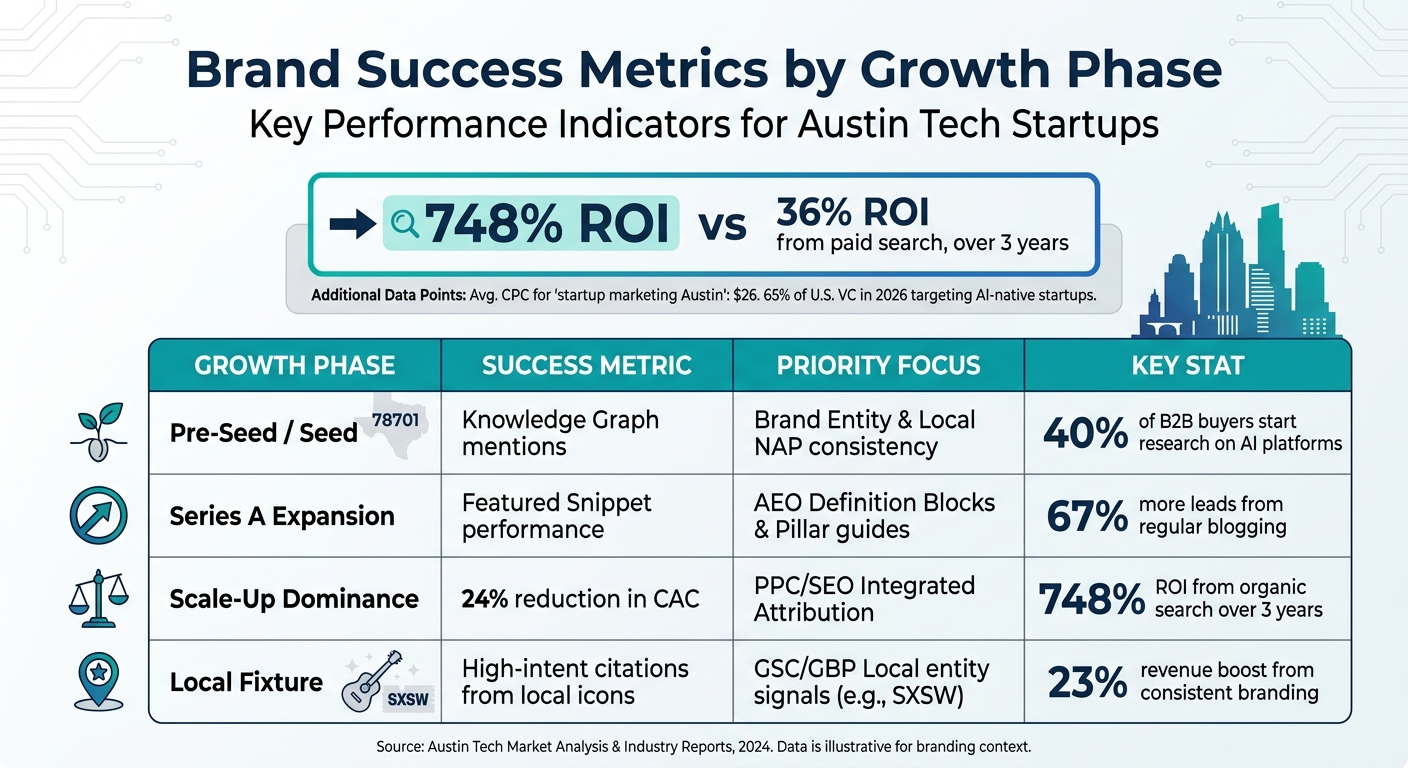
Brand Success Metrics by Growth Phase for Austin Tech Companies
Key Metrics for Brand Success
In Austin’s competitive tech scene, success hinges on moving beyond vanity metrics. A key focus is CAC Efficiency – reducing customer acquisition costs by establishing organic authority. Heet Barot, an AI & Search Visibility Strategist, puts it this way:
"The best strategy is ‘CAC Efficiency’ – reducing your cost per acquisition by building ‘topical authority’ that allows you to rank organically for high-value technical terms".
Tracking Knowledge Graph mentions is essential for confirming your brand’s AI authority. With nearly 40% of B2B buyers now starting their research on AI platforms instead of traditional search engines, being part of AI-generated answers is becoming more critical than simply ranking on search engine results pages. Additionally, monitoring Featured Snippet performance in Google Search Console for Austin-specific queries, such as those tied to ZIP code 78701, can provide valuable insights.
For B2B tech companies, review momentum on platforms like G2 and Google serves as a major trust indicator. Consistent branding across platforms can boost revenue by 23%. Ensuring NAP (Name, Address, Phone) consistency across Crunchbase, your website footer, and directories is crucial for maintaining AI model confidence. Organic search, with its impressive ROI of 748% over three years, far outpaces the 36% ROI of paid search.
| Growth Phase | Success Metric | Priority Focus |
|---|---|---|
| Pre-Seed / Seed | Knowledge Graph mentions | Brand Entity & Local NAP consistency |
| Series A Expansion | Featured Snippet performance | AEO Definition Blocks & Pillar guides |
| Scale-Up Dominance | 24% reduction in CAC | PPC/SEO Integrated Attribution |
| Local Fixture | High-intent citations from local icons | GSC/GBP Local entity signals (e.g., SXSW) |
Once these metrics are in place, the next step is refining your strategy to ensure consistent growth in Austin’s ever-evolving tech landscape.
Refining Your Brand for Long-Term Growth
As your metrics begin to show progress, it’s essential to adjust your brand strategy to align with changing market trends and future opportunities. Your approach should grow alongside your company’s maturity and the shifts in Austin’s tech ecosystem. By 2026, with 65% of U.S. venture capital expected to target AI-native startups, companies outside this niche must focus on technical pillar content. Publishing detailed, 1,500+ word technical guides with high semantic density will be necessary to gain visibility in AI agent recommendations.
Incorporate LocalBusiness schema markup with precise Downtown Austin geo-coordinates to strengthen your local signals. Audit your "About" pages to ensure that founding dates, mission statements, and founder credentials are clearly presented. This helps AI agents construct a structured profile for your brand.
Leverage Google Search Console to track impressions and lead source attribution, which will help validate the impact of your authority-building efforts. Considering the average cost-per-click for "startup marketing Austin" is $26, reducing reliance on paid ads by building organic authority can lead to significant long-term savings. In a market where investors often use search data to gauge a startup’s market share before making funding decisions, your online presence directly influences your ability to attract both capital and talent.
Conclusion: Building a Brand That Thrives in Austin
Creating a strong brand in Austin goes far beyond designing a logo – it’s about crafting a strategy that connects with people on every level.
Austin remains a hub for venture capital investment, making the competition for attention, talent, and funding fiercer than ever. To stand out, your brand needs to be a digital presence that AI tools, investors, and customers can instantly identify and trust at every interaction.
The days of quick wins through growth hacking are fading. Instead, building authority has taken center stage. Organic search strategies driven by authority consistently outperform paid advertising. Companies that focus on technical SEO, cornerstone content, and maintaining accurate NAP (Name, Address, Phone number) data are often the ones that rise to the top. For many startups, the inability to carve out a unique identity in saturated markets is a key factor behind why 90% fail within five years.
As George Kozmetsky, former Dean at the University of Texas, once posed:
"If we don’t create a vibrant business community, where will our grandchildren work?"
Thriving in Austin’s fast-paced tech ecosystem means looking beyond short-term goals. It’s about weaving your mission into every part of your brand – from the content you create to the technical foundation you build.
At Dreamtown Creative, we specialize in crafting brand strategies that seamlessly combine visual identity, technical SEO, and growth objectives to help businesses succeed in Austin’s dynamic market.
FAQs
How do I know my positioning is actually unique in Austin?
To stand out in Austin’s market, emphasize what makes your brand different – your story, the value you bring, and how you approach the market. Incorporate local touches by tapping into Austin-specific trends, community priorities, and even well-known landmarks. Build credibility by participating in local tech events and fine-tuning your SEO to target Austin audiences. A well-defined position should highlight your uniqueness and connect with the local community through consistent messaging and smart differentiation.
What should a “Minimum Viable Brand” include for a startup?
A "Minimum Viable Brand" (MVB) is essential for startups aiming to establish trust and stand out in competitive markets. At its core, an MVB should include these key elements:
- A Clear Story: Highlight the problem your company solves and why it matters. This story sets the stage for your brand’s purpose and value.
- Unique Positioning: Define what makes your company different. This helps your brand carve out a distinct place in the market.
- Consistency: Ensure your visual identity (like logos and colors) and messaging align across all platforms. Consistency builds recognition and trust.
By focusing on these elements, your brand can align with your business goals, communicate effectively with your audience, and lay the groundwork for future growth.
Which brand metrics matter most for AI search visibility?
Key metrics for boosting AI search visibility include verifiable entity authority, a well-structured technical search setup, and localized market signals like accurate NAP (Name, Address, Phone) details and strong local presence. These factors enable AI systems to better identify and promote your brand in search results.
Related Blog Posts
- Beyond Templates: Tailored Branding Strategies for Competitive Tech and Startup Markets
- From Vision to Visibility: Building Scalable Brands in a Disrupted Search Landscape
- Your Brand, Amplified: Creative Solutions for Results-Focused Leaders
- Silicon Hills Storytelling: Crafting a Brand Strategy for Disruptive Tech